I love days like this: 6:40pm and I’m still in my pyjamas. I spent most of this glorious day working on my manuscript, refusing to be distracted. I’m flying through it – twenty-three pages in seven hours! At this rate I should be finished by Christmas of 2018. 😛
For anyone who has been reading the story that is developing on my fiction blog through the A-Z Challenge, please note that I’m flying by the seat of my pants. I have no idea where the story is going. In fact, I didn’t even realize there would be a story when I started it. My intention was to write twenty-six short pieces. So if it suddenly veers off in a completely unexpected direction, (with or without squirrels–thanks Paul) that will probably be me either having had a very bad day or winning the lottery. Preferably the latter.
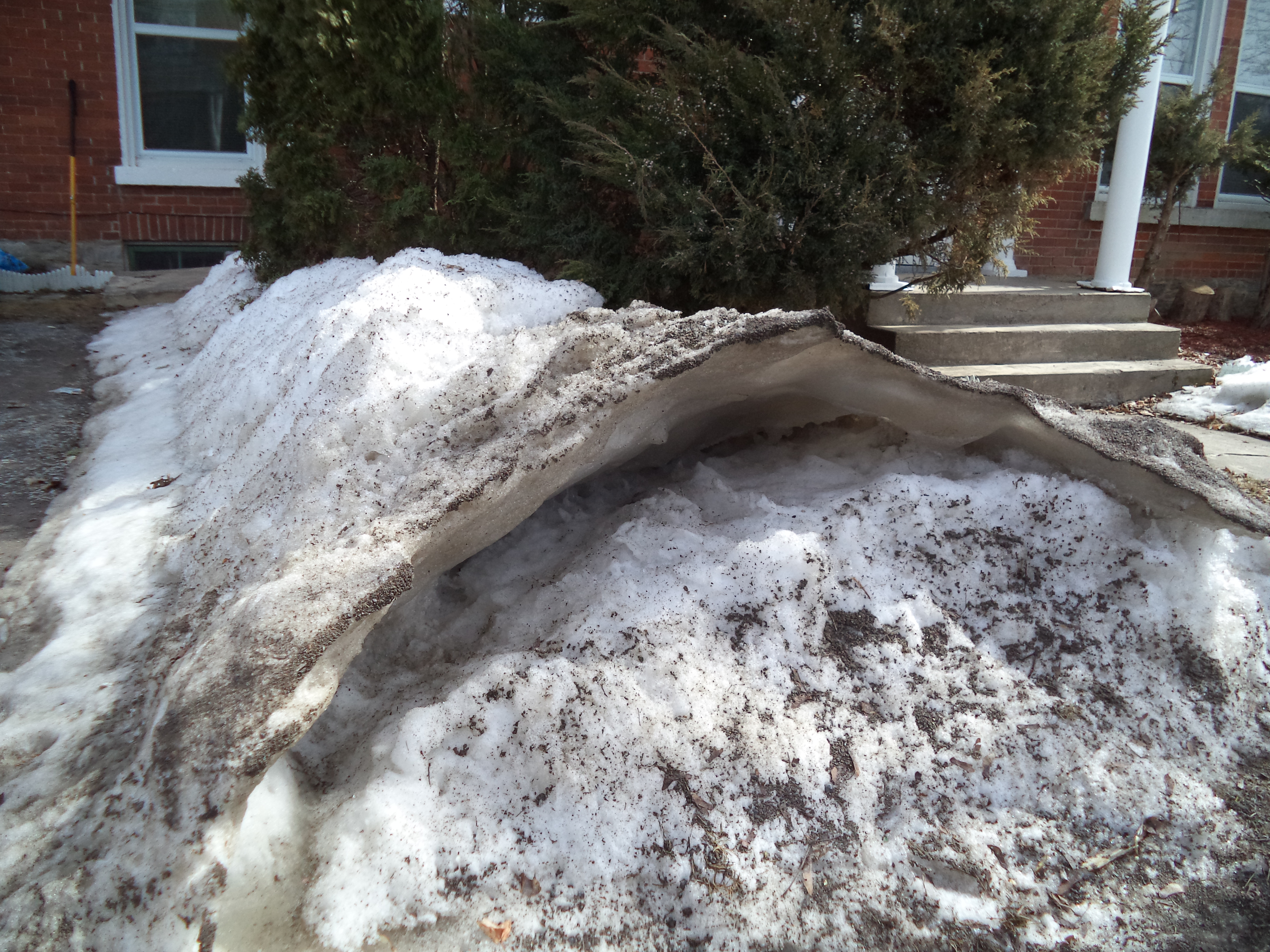
In the interest of keeping this post completely random, here’s some weird snow:
Photo taken late last week
It’s warmed up considerably since then (10 degrees today – time to get the shorts out!) so this little squirrel snow-fort is probably gone already.
They say, ‘write what you know,’ but does that mean if you’re not an astronaut, you can’t write about astronauts? Okay, maybe it helps, but that’s what research is for. Personally, I take the rule of, ‘write what you know’ a little more loosely than that.
Take, for instance, yesterday’s post where I used the example, ‘The steamy kitchen reeked like a wet cat,’ when showing what better detail looked like. Had anyone asked me what a wet cat smells like, I would have had to tell them that I honestly have no idea. I’ve never owned a cat, let alone a wet one. In other words, I think it’s the details where our experience really comes in handy.
Having said that, not all things can really be described. 99.9% of us have had at least a sip of water, but can you describe the taste? And take, for instance, what it’s like to urinate. We’ve all (100% of us this time I think) done it, but if I’m writing from the point of view of a male, I’m unable to accurately describe the action of doing so standing up. Does that mean I shouldn’t write from the male perspective? Again, research comes in handy. I can ask other people (preferably male ones) to tell me what it’s like, but I still won’t have had the experience. And so I’ll probably never write a story in which my male character is dealing with bladder issues. Either that or, like the wet cat, I’ll get good at faking it.
My novel takes place in a real city: Kingston, Ontario, Canada. I don’t live there, but I’ve been there many times, and thought I knew the place well enough to be able to set a story there. Said story written, I decided to take the time to vacation there for a few days by myself, to really do some research, and I was amazed at what I gleaned. Because my characters get off the train there at the beginning of the novel, the station was one of my obvious places to visit. I sat to wait for the westbound train and whist there, noted the colours of the waiting room seats, the landscape outside – even the way the doors worked. When the train stopped I watched to see which track it was on, so I knew my characters would disembark on the nearside of the station rather than having to take the underground passage to get across. All of this will come to perhaps a sentence or two in the novel, but I believe it will add to the feel, as well as have the people who live in Kingston nodding in agreement when they read my book. I could never have accomplished this from information I took from Wikipedia; I had to experience it for myself.
Other life experiences from my past also often manage to creep into my stories. What comes through most vividly for my characters to experience are the wonders of nature I have had the gift of being part of. There’s nothing quite like the quiet of a country field on a snowy night, or the singing of cicadas on a sweltering summer afternoon. These are the things that make fiction come to life. Real life.
Can you tell when something is contrived in a story?
I’ve bemoaned, before, the difficulty I’m having in trying to cut down the length of my manuscript whilst keeping the important little details intact – and at the same time making it readable. In a much broader sense than the idiom perhaps implies, the devil is in the details.
After letting my ex read the beginning of my novel a couple of weeks ago, I know now that my problems are indeed serious. When we were together he was not only my sounding board, he was the one I wrote to impress, and impress him I did with the details I put into my stories. He told me that they were what drew him in, placed him in the story so that he could feel as though it was going on around him. Two weeks ago, however, the first criticism he gave me was, “Where’s the detail?” I knew I was screwed.
While you might want to scream at me, “He’s your ex, Linda! Of course he’s going to criticize!”, I know he wants me to succeed – and I’m sure it has absolutely NOTHING to do with the fact that if I make millions off this book he won’t have to pay child support. Heh.
So what is detail, and how am I to know the extent to which I should go to add it? I personally don’t like to read a book where every nook and cranny is described; every piece of clothing, or each hair that is blown out of place. I think the most important details are the ones that stimulate the senses. They say the sense of smell brings the most vivid memories to mind, yet ironically it’s the one I most often forget, and have to insert into a scene after it’s written.
For me, the most efficient way to add detail is to eliminate the passive voice. Just one example and I’ll leave it there – the rest I’ll save for my fiction post.
It was hot and smelly in the kitchen.
vs
The steamy kitchen reeked of wet cat. What were they cooking?
The detail adds to the word count. And yet which would you rather spend time reading?
We’ve discussed it here in the past and the general consensus seemed to be that most people would rather read a longer well-written book than a shorter one that sucked. I agree. It’s why I read Stephen King.
What I’d love to know today is, what kinds of detail do you enjoy? Do you want to know what every character looks like or would you rather use your own imagination? Do you want to know what they’re wearing down to the designer, or is a pair of starched jeans enough to tell you that they go to way too much trouble with their laundry?
There’s nothing like a good critique of your work, is there? But how do you go about getting it?
Long, long ago–maybe about two years (I have a short attention span)–I was afraid to share my words with the world. I was scared that someone would steal my stories, and so I was hesitant to allow anyone to read them. When I did finally break down to hand my manuscripts to people to read, I limited the exposure to friends and family. The drawback is that typically all I received in feedback was, “That was nice!” or “I liked it!” which is great, except it doesn’t help. I wanted to know what was wrong with it. I know now that my first manuscript sucks as far as style and grammar go, but still, the only feedback I’ve ever received is positive.
The solution must be to give my manuscripts to people who will dissect them. Pull them apart, tear the words to shreds and hand them back to me in a green garbage bag to put back together. Still, for fear of seeming mean, unless I’m paying someone to do it, it’s difficult to find somebody with that sort of gumption. But I’m guilty of the same thing! I fully acknowledge that critiquing is a difficult task. Telling someone what they’ve spent the last year bleeding from the soul on needs a complete overhaul is painful for everyone. And believe me, I’ve wanted to tell authors that their hard work sucks dusty ping-pong balls, yet I either found it difficult or avoided it altogether.
Is it better to leave the job to a professional? Or do you ask those who have an emotional attachment to the task? Personally, I say pay for that whipping, baby! It’ll probably make you a better writer.
It’s the on-again, off-again, great blogging debate: why do writers have blogs? In my own experience, my reasoning has evolved, and in a very satisfying way.
At the same time I discovered WordPress, I was told that if I wanted to write and get my name ‘out there,’ I should start a blog. The scariest part was deciding to use my real name; then came deciding what to actually write about. While that particular choice hasn’t evolved much, what I have found as the biggest surprise, is the community here. I got my name out all right – but I hardly have publishers knocking on my door.
There are many different reasons for a writer to blog. My personal favourites are; to build an audience for that eventual bestseller; to keep in the practice of writing, especially while editing; and the best one of all: to have easy access and a (good) excuse to procrastinate, rather than edit the above-mentioned eventual bestseller.
I suppose if I do ever get off my butt and start sending out queries to magazines and the like, I may be able to use this blog as a sample of my work. We all have to start somewhere, and it’s really the age-old question – what do you put on a resume when you have no previous experience? Well, here’s my experience right here. But again, am I just using the blog to procrastinate?
One way or another, the very best part of this whole blogging experience is the wonderful people here on WordPress. Even if I never make it to the bestseller lists, I will always have this great community of people who are as dedicated to writing (and art and photography) as I am. If I’ve gained anything, it’s the valuable insight and fantastic friendships – and I’m meeting more people every day. What could be better?
It would be interesting to know if your reasons for blogging are the same now as they were when you started. Are you as surprised as I am at the support you’ve gained here? I know without it, I may just have fizzled out by now – both as a blogger and as a novelist with an erstwhile eventual bestseller.
For the short fiction that goes with this post, please visit my fiction blog here: B is for … Bob the Blogger.
“Well, it’s about a girl who leaves home and meets a magician.”
“Oh. That sounds … nice.”
“But his family has this deep dark secret.”
(Best case scenario.) Their eyebrows lift a notch. “That sounds intriguing!”
(What usually happens because I lost them after the word ‘magician.’) “What? I was paying attention to something else.”
Explaining what your story is about can be the most difficult thing. From what I’ve discovered by experience, it’s even harder than writing a blurb – because at least with a blurb, if someone is going to bother reading it, they’ve probably committed themselves mentally to paying attention to at least two sentences – one more than you’ve got to grab them with in conversation.
Trying to explain what I do, off the top of my head, is never easy. I don’t have a natural gift for talking about myself. That’s why I write. And so I’m thinking that this may be one of the major reasons that it’s not a good idea to talk about being an author at all.
Before I do, however, publish my novel, I’ll be sure to write myself a sentence which I will recite verbatim whenever anyone asks.

 lindaghill.com