Life in progress


28 Comments

F is for … Finding Characters

Characters are everywhere. Inspiration can be found for them in both the most obvious places and, at times, from the most unexpected.

Take for example when I was searching for inspiration for my Short Story course: I sat in the food court at the mall, alone, eating my Chinese noodles with chopsticks, (I wonder if I’m a character in someone else’s story?) and I people-watched. I do this as often as I can.

While I was slurping up my noodles, I noticed a thirty-something man, casually dressed, walking with an elderly lady on his arm. The woman was just about ready for a walker, but if she’s anything like my own mother, she probably wasn’t ready to admit it. Plot and conflict came to me instantaneously. All I had to do was look at the man and figure out what his problem might be. He became a guy with a career and a weird fetish. His elderly mother could no longer take care of herself so he was faced with the decision of either living his life the way he wanted to, or looking after his mother. At that moment the short story, “On Loyalty” was born, for which I received a mark of A+.

Settings, for me, are the light bulb that rarely flashes inspiration but when it does, it’s usually brilliant – not me, the light bulb. The main characters in my novel came from an abandoned bicycle (who left it there and where were they going?) and a burned out railroad station (a mad magician takes his kidnap victims there to experiment on making them disappear). I put the two together and ended up with a 214K word novel. The mad magician turned into a good guy, but here you can see where I got the idea from. The train station makes an appearance in the story – fixed up and turned into a night club.

Characters can be found in the strangest places. I think even non-writers get ideas for people they see – it’s part of what we do as human beings when we notice the way people are dressed and listen to the way they talk. Yes, it’s slightly judgmental, but whether or not we comment on it, our brains connect situations from past experience to what we are seeing – like it or not.

Do you ever consciously do it? Do you sometimes make up stories for people you see? And if you’re a writer, what is the weirdest place you’ve found a character for a story?

For the corresponding short fiction on the subject of finding characters, click here: http://lindaghillfiction.wordpress.com/2014/04/07/f-is-for-friends-will-be-friends/

20 Comments

Random is as Random Does

I love days like this: 6:40pm and I’m still in my pyjamas. I spent most of this glorious day working on my manuscript, refusing to be distracted. I’m flying through it – twenty-three pages in seven hours! At this rate I should be finished by Christmas of 2018. 😛

For anyone who has been reading the story that is developing on my fiction blog through the A-Z Challenge, please note that I’m flying by the seat of my pants. I have no idea where the story is going. In fact, I didn’t even realize there would be a story when I started it. My intention was to write twenty-six short pieces. So if it suddenly veers off in a completely unexpected direction, (with or without squirrels–thanks Paul) that will probably be me either having had a very bad day or winning the lottery. Preferably the latter.

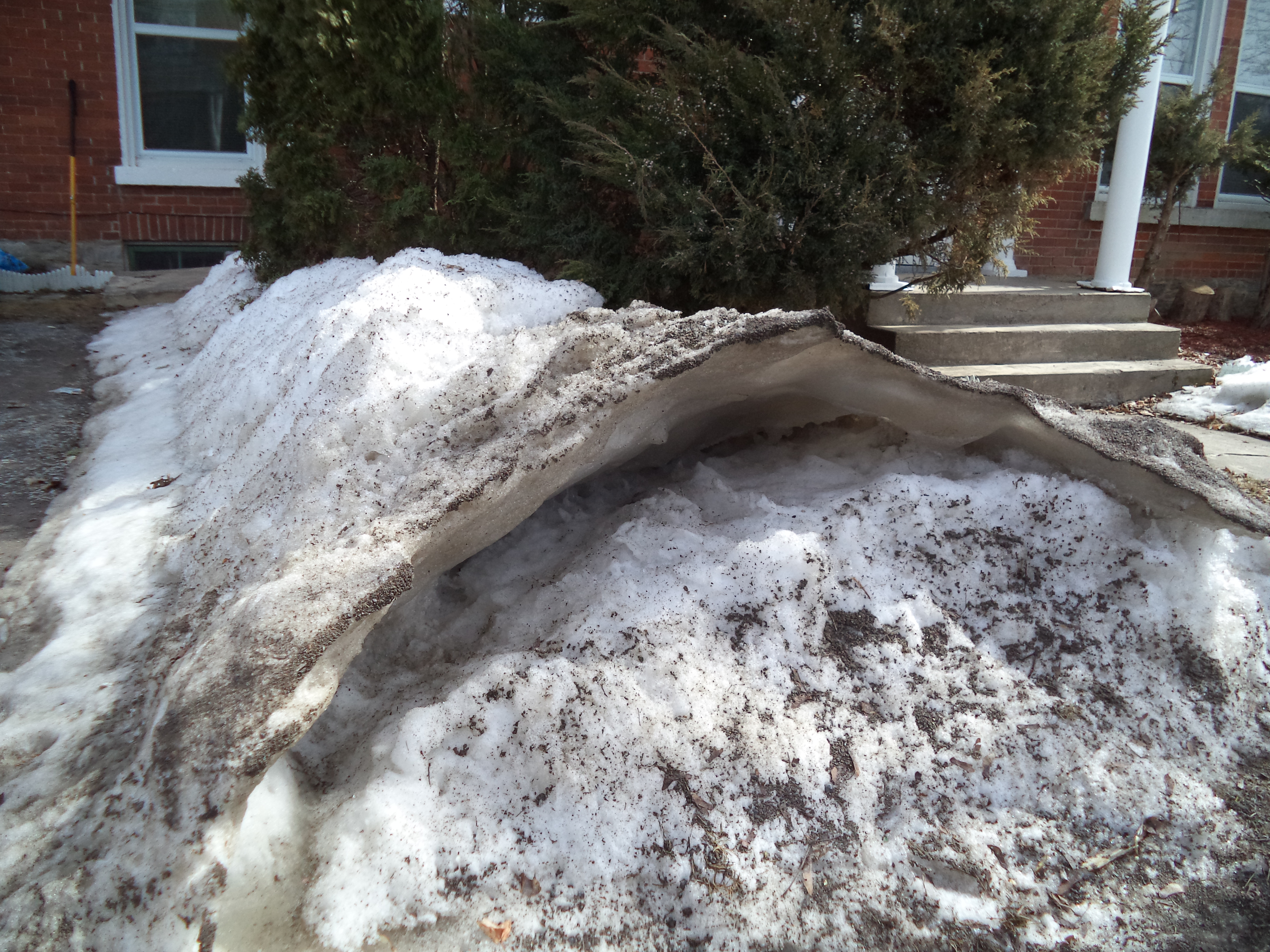
In the interest of keeping this post completely random, here’s some weird snow:

DSC00086

Photo taken late last week


It’s warmed up considerably since then (10 degrees today – time to get the shorts out!) so this little squirrel snow-fort is probably gone already.

And last but not least, we had great success with this weekend’s Stream of Consciousness Saturday, picking up a few new participants. Go here: https://lindaghill.wordpress.com/2014/04/04/the-friday-reminder-and-prompt-for-socs-april-514/ and check the comments to make sure you didn’t miss any!

Hope everyone is having a great Sunday (or Monday, depending where in the world you are).

Cheers!


21 Comments

E is for … Experience

They say, ‘write what you know,’ but does that mean if you’re not an astronaut, you can’t write about astronauts? Okay, maybe it helps, but that’s what research is for. Personally, I take the rule of, ‘write what you know’ a little more loosely than that.

Take, for instance, yesterday’s post where I used the example, ‘The steamy kitchen reeked like a wet cat,’ when showing what better detail looked like. Had anyone asked me what a wet cat smells like, I would have had to tell them that I honestly have no idea. I’ve never owned a cat, let alone a wet one. In other words, I think it’s the details where our experience really comes in handy.

Having said that, not all things can really be described. 99.9% of us have had at least a sip of water, but can you describe the taste? And take, for instance, what it’s like to urinate. We’ve all (100% of us this time I think) done it, but if I’m writing from the point of view of a male, I’m unable to accurately describe the action of doing so standing up. Does that mean I shouldn’t write from the male perspective? Again, research comes in handy. I can ask other people (preferably male ones) to tell me what it’s like, but I still won’t have had the experience. And so I’ll probably never write a story in which my male character is dealing with bladder issues. Either that or, like the wet cat, I’ll get good at faking it.

My novel takes place in a real city: Kingston, Ontario, Canada. I don’t live there, but I’ve been there many times, and thought I knew the place well enough to be able to set a story there. Said story written, I decided to take the time to vacation there for a few days by myself, to really do some research, and I was amazed at what I gleaned. Because my characters get off the train there at the beginning of the novel, the station was one of my obvious places to visit. I sat to wait for the westbound train and whist there, noted the colours of the waiting room seats, the landscape outside – even the way the doors worked. When the train stopped I watched to see which track it was on, so I knew my characters would disembark on the nearside of the station rather than having to take the underground passage to get across. All of this will come to perhaps a sentence or two in the novel, but I believe it will add to the feel, as well as have the people who live in Kingston nodding in agreement when they read my book. I could never have accomplished this from information I took from Wikipedia; I had to experience it for myself.

Other life experiences from my past also often manage to creep into my stories. What comes through most vividly for my characters to experience are the wonders of nature I have had the gift of being part of.  There’s nothing quite like the quiet of a country field on a snowy night, or the singing of cicadas on a sweltering summer afternoon. These are the things that make fiction come to life. Real life.

Can you tell when something is contrived in a story?


For today’s A-Z Fiction, please click here: http://lindaghillfiction.wordpress.com/2014/04/05/e-is-for-elementary-dear-jupiter/


37 Comments

D is for … Detail

I’ve bemoaned, before, the difficulty I’m having in trying to cut down the length of my manuscript whilst keeping the important little details intact – and at the same time making it readable.  In a much broader sense than the idiom perhaps implies, the devil is in the details.

From http://www.usingenglish.com/reference/idioms/devil+is+in+the+detail.html – “When people say that the devil in the detail, they mean that small things in plans and schemes that are often overlooked can cause serious problems later on.”

After letting my ex read the beginning of my novel a couple of weeks ago, I know now that my problems are indeed serious. When we were together he was not only my sounding board, he was the one I wrote to impress, and impress him I did with the details I put into my stories. He told me that they were what drew him in, placed him in the story so that he could feel as though it was going on around him. Two weeks ago, however, the first criticism he gave me was, “Where’s the detail?” I knew I was screwed.

While you might want to scream at me, “He’s your ex, Linda! Of course he’s going to criticize!”, I know he wants me to succeed – and I’m sure it has absolutely NOTHING to do with the fact that if I make millions off this book he won’t have to pay child support. Heh.

So what is detail, and how am I to know the extent to which I should go to add it? I personally don’t like to read a book where every nook and cranny is described; every piece of clothing, or each hair that is blown out of place. I think the most important details are the ones that stimulate the senses.  They say the sense of smell brings the most vivid memories to mind, yet ironically it’s the one I most often forget, and have to insert into a scene after it’s written.

For me, the most efficient way to add detail is to eliminate the passive voice. Just one example and I’ll leave it there – the rest I’ll save for my fiction post.

It was hot and smelly in the kitchen.

vs

The steamy kitchen reeked of wet cat. What were they cooking?

The detail adds to the word count. And yet which would you rather spend time reading?

We’ve discussed it here in the past and the general consensus seemed to be that most people would rather read a longer well-written book than a shorter one that sucked. I agree. It’s why I read Stephen King.

What I’d love to know today is, what kinds of detail do you enjoy? Do you want to know what every character looks like or would you rather use your own imagination? Do you want to know what they’re wearing down to the designer, or is a pair of starched jeans enough to tell you that they go to way too much trouble with their laundry?


After you’ve commented, please visit my fiction blog for today’s A-Z installment, to see what I’ve done to demonstrate today’s topic! Find it here: http://lindaghillfiction.wordpress.com/2014/04/04/d-is-for-devil-in-the-details/

Thanks!