Life in progress


17 Comments

Interpreters – #AtoZ Challenge

I remember the first time someone called me using TTY plus Telephone Relay Service. The way it works is, the telephone company has a hearing interpreter with a TTY (teletype) device between the hearing person and the Deaf person. On the Deaf person’s end, they are either watching the interpreter sign on screen, or reading on the device. In between, the interpreter is listening and signing or typing, and on the hearing person’s end, he or she must speak and then say, “Go ahead,” when finished. It’s a complicated, and at first awkward, but effective method of communicating.

I also remember the first time I spoke to a Deaf person through an interpreter face-to-face. Again, awkward. First, I wasn’t sure where to look. When the Deaf person signed to me, I was able to watch and listen to the interpreter at the same time. But when I spoke, the Deaf person watched the interpreter. I wasn’t sure who I should be looking at. I’ve since gotten a bit more used to it. Second, I never know how fast to talk. I get caught up in watching the signs, and when I catch one I know, I realize how far behind the interpreter is, so I slow down. …or is he/she behind? There’s the backwards grammar to take into consideration too.

I didn’t have to deal with any of this until we moved to Ontario and Alex was enrolled in a Deaf school. Appalling anecdote, that was part of what actually led me to move:

It took about a year to finally have a speech and language pathologist visit Alex at school. It was a regular, English-speaking public school in the Province of Quebec. He had a wonderful EA working with him there, by the name of Lise. She was with him all the time. She spent her lunches tube feeding him and playing with him, and she actually came out of town to visit the Deaf school with me before we moved. Lise is hearing, however, and was at about the same level of American Sign Language I. We both knew it wasn’t enough for him to grow, so enter the speech therapist to advise on whether or not the school should fund an interpreter for him. The pathologist’s final assessment, after watching him in class a couple of times was that he couldn’t benefit from an interpreter, because at his current level of ASL, he wouldn’t understand the interpreter.

It’s like saying adults shouldn’t speak to hearing toddlers because they won’t understand anyway. How does one learn a language unless they are taught by someone who knows more, and is able to expand their vocabulary by example? And this from a woman whose job it was to teach language!

So we moved.

Since then, I’ve been muddling along, learning from what Alex brings home from school more than anything. We learned together, him by being exposed to ASL daily, and me from being exposed to my son. But we’re slowly getting back to needing an interpreter, and I don’t think it will be long before I have to have one at doctor’s appointments. He can now understand most things that are said in the adult world. At fifteen years of age he is still quite far behind mentally, but he’s a teenager. One of the most difficult things for me is knowing where his actual level of understanding lies. I have to rely on teachers for that. It’s like hosting a foreign student who I gave birth to, sometimes.

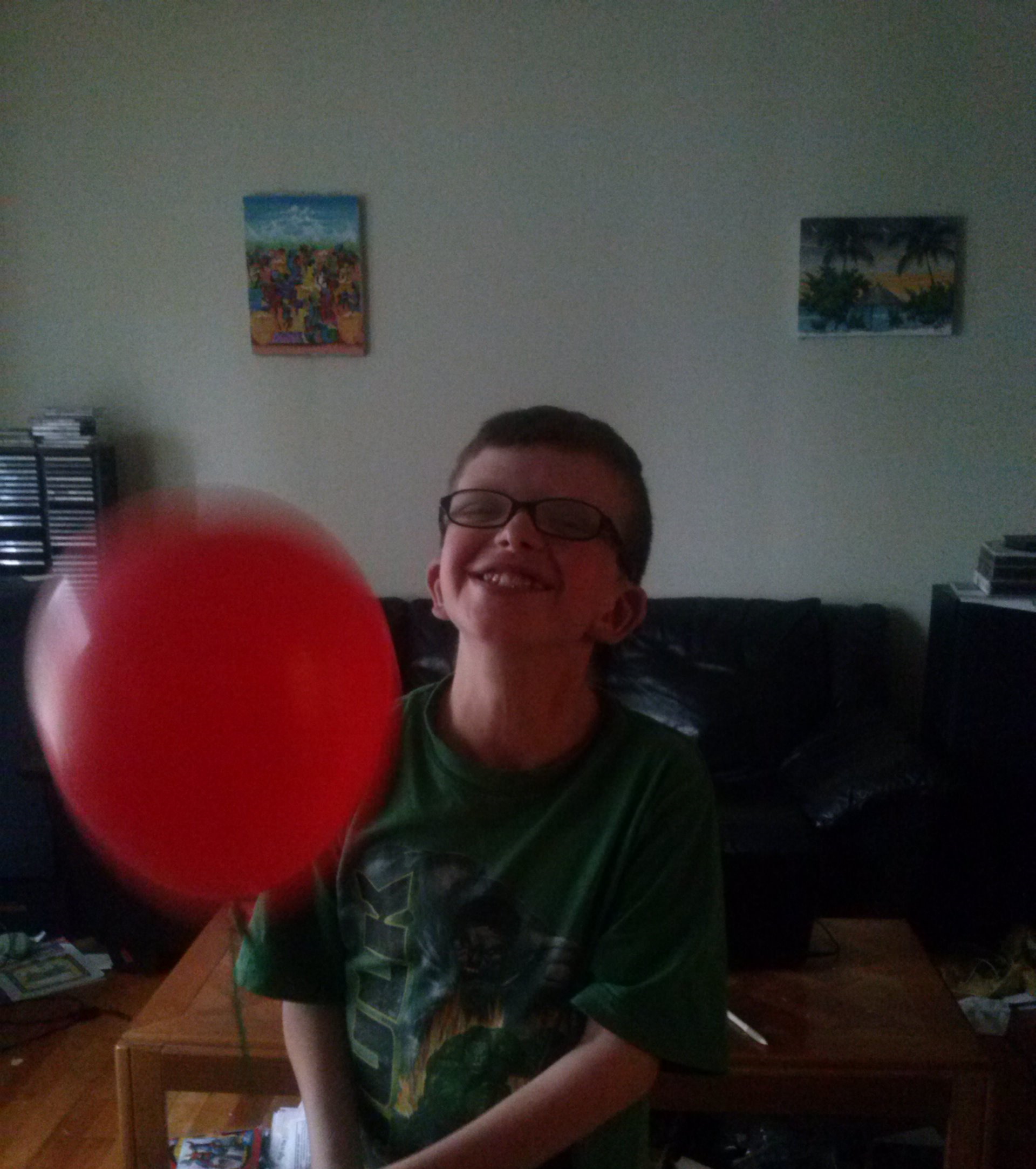
Alex balloon

My A to Z theme concerns the joys and challenges of being the hearing mother of my Deaf son, Alex. To learn more about his beginnings in life, click here to go to my first A to Z entry.
39 Comments

Hearing world – #AtoZ Challenge

Deaf people have to survive in a hearing world. This is a fact. If there are such things as Deaf stores, and Deaf hospitals, I don’t know of them. There are, of course, Deaf people working in public service positions–my bank has a Deaf teller–but it’s uncommon.

As the parent of a Deaf child who is growing up and will one day, hopefully, be independent, the fact that my son will out alone in a society that views him as different, is a concern for me. Alex is at a disadvantage, having not grown up exposed to his first language as most children are. Immersion into American Sign Language didn’t happen, and so by the time he reached the Deaf school that he now attends, he was years behind many of his peers. But at the same time he has an advantage. He’s already learned how to communicate, somewhat, with the hearing. He has an innate understanding that he needs to demonstrate what he wants without being able to verbalize. He has adapted.

On the flip side, I remember a story that my ASL teacher told us when I was in my third year of classes. He was the only Deaf member of his family. He told us of family gatherings and dinners when he was a child and through his teenage years when he would sit and eat, and no one would talk to him. They were all busy yammering away; he said he felt completely isolated. Consequently, he moved away–right out of the province–and had stayed away since. I can’t say he hated his family, but he seemed extremely bitter.

I fear this happening to Alex. I try my best to translate for him during dinners, but it’s difficult. First, keeping up with the conversation in ASL when my vocabulary isn’t up to par, and second, signing with a knife and fork in my hands. Despite this, he seems well-adjusted. I do what I can to make sure he’s included, at least in discussions that concern him. It’s more difficult when I’m talking with someone about something that doesn’t – with hearing kids, boring adult talk is naturally tuned out. Again, he’s at a disadvantage – if he was part of a Deaf family, he’d know to ignore it without having to be told it doesn’t concern him. On my end, I’m constantly saying to him, “It’s nothing.” I can only hope that he can tell by my body language and facial expression that I’m being sincere, and not just dismissing him as unimportant.

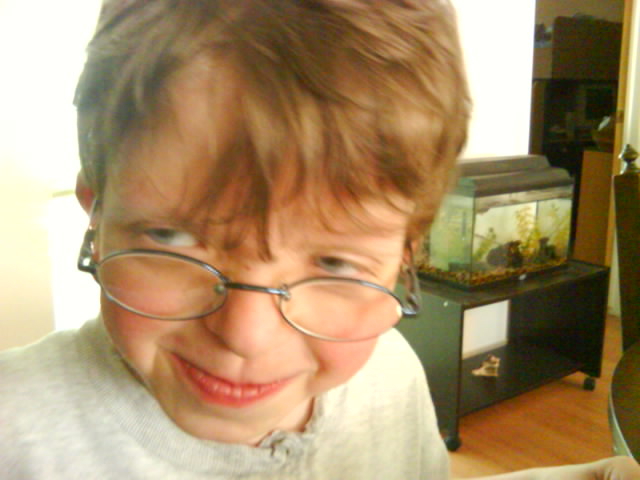
Alex, 2009. His usual charming self.

My A to Z theme concerns the joys and challenges of being the hearing mother of my Deaf son, Alex. To learn more about his beginnings in life, click here to go to my first A to Z entry.


31 Comments

Grammar – #AtoZ Challenge

You might think that American Sign Language is an extension of English, and therefore the grammar is the same. It’s not. This creates a bit of a sense of multi-tasking whilst trying to speak and sign at the same time, but with practice it can be done. I know my Sign grammar is not great, but there are a few things that are easy to remember, and a few that are necessary.

One thing I learned fairly quickly NOT to do, is say to my Deaf son, Alex, “Look at that!” when I want him to notice, say, a bird flying overhead. If I say, “Look, a bird!” it’s totally wrong. Why? Because if I sign “Look!” or even point at something, I’ve lost Alex’s attention on myself, so he has no idea what he’s looking for. If he could hear, he’d listen for further instruction. But he’s Deaf. So while he’s gazing out he window at the trees, I’m wildly signing the word “bird” for my own benefit. The proper way to do it in ASL is, “A bird, look!” Alex will then know what to look for. ASL grammar is important.

Another instance is the verb “to be.” It’s pretty much eliminated from ASL. Unlike Signed English, which, to quote Google, “…is a sign language dialect which matches each spoken word of English,” ASL, as you may have guessed, has a grammar unique to the needs of Deaf people. If I want to say “I am going,” I sign, “I go.” If I want to say, “I went,” I sign, “I go finished.” For a visual https://www.signingsavvy.com/sign/WENT/6576/1 I often speak to Alex out loud when I sign to him, and many times, since my brain is rarely up to multi-tasking, I’ll say exactly what I’m signing, which must sound quite funny to anyone listening.

Because tenses are pretty much non-existent in ASL it’s important to mention the “when” at the beginning of a sentence, when the action will take place in the future. For example, “Tomorrow, we go to the toy store.” This has become an ingrained part of Alex’s sentence structure. Which means if I say it backwards: “We’re going to the toy store tomorrow,” Alex gets his coat on first, and then waits to find out what we’re doing tomorrow.

It really takes grammar-nazi-ism to a whole new level.

My A to Z theme concerns the joys and challenges of being the hearing mother of my Deaf son, Alex. To learn more about his beginnings in life, click here to go to my first A to Z entry.


27 Comments

Facts of Life – #AtoZ Challenge

When learning any language, we start with the basics, introducing ourselves, explaining where we live, etc. Then we begin to learn the names of things so we can ask for them. All of this is fairly straightforward. But when we learn a new language, we’re normally doing it for ourselves, for travel or to communicate with a native speaker. We’re not usually learning it in order to teach a child his or her first language.

While pointing and naming is all well and good, children ask why things are the way they are. It’s practical. How do we know the difference between the consequences of stealing a cookie versus running out into the middle of a busy intersection? Hopefully not by experience. Obviously, the consequences of getting hit by a car was something I learned to communicate to Alex early on. But what about the more innocent stuff?

Why is the sky blue? How do wireless electronics work? Why is this Russian/Korean/Indian show on my laptop but it’s not on TV, like The Price is Right is? (He watches shows from all over the world; spoken language is of no consequence to him.) I have no way to answer many of his questions, short of becoming completely fluent in Sign Language. The closest place to receive such an education is in Toronto (Ontario, Canada), which is too far to commute to, to take classes I have neither the time nor the money for at the moment.

I might have advanced my education more after Alex was born, but the courses in Ottawa only went to a certain level. On top of that, we lived in the Province of Quebec – a province that has its own Sign Language (Langue des signes du Québec). Finding a professional to teach Alex American Sign Language in Quebec was next to impossible, and the only Deaf school for children in Ottawa teaches LSQ. So we packed up and moved to Ontario, to a city with a school whose primary language is ASL.

I do hope to learn more Sign someday. For now, I’m doing the best I can with help from his teachers.

My A to Z theme concerns the joys and challenges of being the hearing mother of my Deaf son, Alex. To learn more about his beginnings in life, click here to go to my first A to Z entry.


43 Comments

Communication – #AtoZ Challenge

My A to Z theme concerns the joys and challenges of being the hearing mother of my Deaf son, Alex.

When I discovered Alex was Deaf, I knew I would have to learn Sign Language. However, there was no point starting a formal education too early. I knew from experience that if you don’t use a language, you lose it pretty quickly. So in lieu of classes, I devised a few logical signs of my own. I think the first I ever taught him, before he came home from the hospital at the age of eight months, was to let him know when I was leaving and coming right back. I simply held my index finger up as I walked out the door. When I was leaving for the evening, I waved goodbye so he would know the difference. It didn’t take long before he needed to know why people were exiting his room; he began to cry whenever a nurse left, even for a moment. “Just a second” was the first of many I would have to teach the nursing staff over the years. I found the signs for “mom” and “dad,” and a few others so I could add to both my vocabulary and that of the people caring for him in the hospital when I couldn’t be there myself.

Even now, fifteen years later, it’s necessary to teach the nursing staff how to sign whenever he stays in the hospital. And not just one nurse, because signing is usually the last thing they have time to relate to each other when they change shifts. They normally have 15 minutes to go through the medical history and changes of all the patients on the floor. If Alex is admitted for a few days, there’s a fair bit of staff rotation. When a hospital is close to a border, such as the Ontario/Quebec border in Canada, the staff are expected to be bilingual, yet there is no provision for teaching hospital staff Sign Language. At the very least, it should be mandatory to have a reference book on every floor. I had to buy one of my own and lend it, always hoping it would come back home after Alex’s stay.

For a child without diverse medical needs, this would only be a problem occasionally. For us, it’s an ongoing concern. I honestly don’t understand why it’s not mandatory to teach Sign in schools. If you follow my A to Z, you may agree with me by the time the end of April gets here that they should.