Life in progress


10 Comments

Quiet – #AtoZ Challenge

I know I’ve mentioned before what it’s like when I visit Alex’s school for a special event. Walking down a hallway, jam-packed with students from Kindergarten to Grade 12, all of them chatting animatedly without a sound but the scuffing of shoes on the floor, is an experience not many hearing people are likely to have. I want to add that the shoe-scuffing is decidedly loud, however. I think that may be because Deaf parents aren’t constantly telling the kids to stop dragging their feet already, like the rest of us do. But I digress.

Unlike the above point, I’m not sure if I’ve mentioned the first time I went with Alex for a playdate. It was back when we lived in the Ottawa area. We only went to a couple, hosted by a Deaf mom, for her kids and some of their friends, all of whom were Deaf. I was lucky to have found them: I was pointed in the right direction by one of my American Sign Language teachers.

My first impression at the playdate, once we got the kids organized and sitting around a table with building blocks, was how eerie it was. If I remember correctly, there were four adults and five or six children ranging in ages from two to six, and the room was dead quiet. What I remember the most was how happy Alex was. At the age of six, Alex was probably more fascinated watching the adults sign and the kids communicate with one another without excluding him than he was with the actual playing. It was at that moment that I realized these were his people and I was not.  As happy as I was for him, and still am, that he’s part of that wonderful community, being unlike him is one of the most heartbreaking things I have to endure as his mother.

It’s very strange to give birth to someone whose first language isn’t the same as yours.

My A to Z theme concerns the joys and challenges of being the hearing mother of my Deaf son, Alex. To learn more about his beginnings in life, click here to go to my first A to Z entry.

11 Comments

Panic – #AtoZ Challenge

For my Deaf son, Alex, there’s no difference between a spider and a fire alarm. He understands what panic looks like, and he knows when I’m in one, but unless I sign why (which is difficult under the circumstances of real panic), then all he can do is wait until someone explains what the commotion is.

I could, and probably should, install special warning alarms in the house for him. The doorbell (first I’d have to get a doorbell) and the smoke detector are the two most obvious things to alert him of.  I haven’t bothered yet because he’s never at home alone. And equipment is expensive. Just an alarm clock that either shakes the bed or lights up (which only works in the dark I’m guessing) …scratch that. I just looked up the cost of one at Walmart and he wants a Spiderman one. They don’t make them. On with a search.

But I digress. There are many circumstances in which a Deaf person can be caught short. Just two examples: alarms in hotels don’t normally exist for the Deaf, and a bomb threat in a shopping mall would leave a Deaf person who was out alone wondering which way to run. We don’t realize how much we rely on our hearing.

Again, another reason for having more people in society who know some sign language. So many things to advocate for, so little time.

The sign, in ASL for “fire”: https://www.signingsavvy.com/sign/FIRE/3459/1

My A to Z theme concerns the joys and challenges of being the hearing mother of my Deaf son, Alex. To learn more about his beginnings in life, click here to go to my first A to Z entry.


27 Comments

Obscenities – #AtoZ Challenge

As the parent of two hearing children I’m cognizant of the need to quell my verbal outbursts when I am not best pleased. I’ve been known, when they were younger, to come out with words such as “schnozzle” after having stubbed a toe, or “fruitcake” having noticed that the thing I wanted to wear hadn’t made it into the laundry. But now that they’re older, and the one child I have left too young to hear the more expressive me can’t hear, I have fewer qualms.

However, (and there’s always a however, isn’t there?) flipping someone the bird after they cut me off in the car remains out of the question. But, (yes, there’s a but as well as a however) there are also accidental signs. Take, for instance, the sign for “very,” which is close to the sign for “fuck.” For “very,” you make a letter “v” (just like a peace sign) with both hands, put the tips of the four extended fingers together and move your two hands away from each other. For a visual, click here: https://www.signingsavvy.com/sign/VERY/7162/1 The sign for “fuck” is the same handshape (the “v”) with both hands, except the movement is different. For this sign, the knuckles knock together… the same as the word “meet,” only with that only the index finger is up. A visual for “meet me”: https://www.signingsavvy.com/sign/MEET%20ME/3877/1

It’s easy to see why you wouldn’t want to mix either “very,” I had a very good time at the fair, or “meet,” There’a a playdate at the park. I’m going to meet my best friend’s husband there, with the word “fuck.” No matter who you’re talking to. Especially your best friend’s mother.

Saying the right thing around Alex can be complicated. The struggle is real.

My A to Z theme concerns the joys and challenges of being the hearing mother of my Deaf son, Alex. To learn more about his beginnings in life, click here to go to my first A to Z entry.


22 Comments

Nighttime Variations – #AtoZ Challenge

Nighttime is much different with a Deaf child than it is with a hearing one. Just how much, I wasn’t able to imagine until I experienced it. When I had my first two kids I quickly learned what their cries meant. I knew whether or not they needed my full or immediate attention, or if they were just whining for a bit of company in the middle of the night. In the case of the latter, I would call out to let them know I was right in the room next door, and that they weren’t completely alone. With Alex, of course, this wasn’t and still is not, an option, even though he’s fifteen years old. So whenever he calls, no matter what the reason, either I have to get up or he comes to me.

The next difficulty: signing in the dark. People who are both deaf and blind learn to sign while touching, but try as I might, I can’t convince Alex to attempt it. So on go the lights which, in the dead of night, blinds us both. And speaking of lights…

They are one of the two things that will wake him up when he’s fast asleep, the other being vibration. I can go into his room and talk normally with no problem, which has been great at times when he’s been in the hospital. The neighbours can party all night long, fans can rattle, his feeding pump can beep, the phone can ring – none of that disturbs him in the least. But if I touch his bed or shine my cell phone in the wrong direction because I’m looking for something, and he’s wide awake. For anyone babysitting, it takes a bit of getting used to. As it will for me, if I ever look after someone else’s child.

My A to Z theme concerns the joys and challenges of being the hearing mother of my Deaf son, Alex. To learn more about his beginnings in life, click here to go to my first A to Z entry.


11 Comments

Music – #AtoZ Challenge

It’s heartbreaking to me, as a music lover, to have to tell my Deaf son, Alex, that there’s no use buying a music video featuring his favourite characters because he can’t hear it anyway. That’s not to say he doesn’t appreciate music in his own way. But my television and sound-system are incompatible, so there’s no way for him to feel the beat as he watches. The same goes for video games. Often they rely on sound. When he was very young, he would see his brothers dance to the music at the end of a movie. He began, then, to associate movie credits to music. To this day he still dances and “sings” (repetitive, monotoned, wordless chants) whenever he sees them.

Alex isn’t totally deaf. If I put headphones on him, he can hear at least a little, but he doesn’t like it. He has a fantastic sense of rhythm, as do many Deaf people – see the current “Dancing with the Stars” for evidence. But unless the music is cranked enough for him to sense it, one could say for the most part, he dances to the beat of his own drummer.

My A to Z theme concerns the joys and challenges of being the hearing mother of my Deaf son, Alex. To learn more about his beginnings in life, click here to go to my first A to Z entry.


14 Comments

Language Learning – #AtoZ Challenge

As I’ve mentioned before, it wasn’t long (30 seconds?) after I found out that my baby, Alex, was deaf before I decided I’d need to learn American Sign Language, though I didn’t start taking classes until he reached the age of about two, if memory serves me right. I knew the alphabet and could count to twenty before I started, so I was ahead of the class in these things. The beginner’s class was basic – learn to spell our names, talk about our families, say where we lived, worked, and how we got there and back. Great stuff if you’re an adult. However, that wasn’t why I was going.

During the second level we learned, among other things, relationships, a few different objects, counting to one-hundred and beyond, and professions. So I was learning the sign for “secretary,” while what I really needed was the sign for “squirrel.” There is nothing on earth quite as frustrating as not being able to explain to your toddler what the simplest, most common things are. For instance:

“What’s that?”

“It’s a bird. Wait, let me look it up.”

(Three minutes later) “It was a bird.”

“What was?”

Obviously neither of us had that much of a vocabulary if we didn’t know what, or how to sign what, a bird was, but you get the idea.

Had I known about Baby Sign, I might have taken the classes. But I didn’t. If it was a “thing” in Ottawa in 2002, I didn’t know it. By the time I finally made it to a Baby Sign class, I was at Level 4 in ASL, and Alex knew all the signs they were teaching the parents. It was interesting though. I’ve heard it’s a wonderful tool for parents–if they’re able to teach it to their kids–to understand their baby’s needs before the child is able to form spoken words. I’d be interested to know if anyone out there used Baby Sign, and if so, how it worked out for you.

Why, if I wasn’t learning anything obviously useful, did I go all the way up to Level 4? Because they were teaching me to see. For three hours a week I had to communicate without using my voice. We sometimes played games where we had to get up in front of the class and fingerspell something, and then another of us had to write it on the board. Tests were signed to us and we had to write down our answers. It was crazy difficult, but it was fun. And it gave an appreciation of how focused a Deaf person must be to understand his or her own language. The Canadian Hearing Society had one program I would have liked to have tried, in which they deafened hearing people. Participants would go in first thing in the morning and have silicone put in their ears. Then they would go out into the community–coffee shops, restaurants, stores, services–with someone from CHS to help, and just survive for the day. The rules were no speaking, and no note writing. It was apparently a real eye-opener, so to speak.

Alex and I muddled through those early years of communicating. I felt lucky to have someone to ask questions of once a week if I was really stuck. Youtube wasn’t around until 2005, (yes, believe it or not we survived without Youtube once upon a time!) and typically, computers couldn’t handle the bandwidth of a video anyway, so I was stuck with books with awkward drawings if I had no human to help. There’s really nothing better than having a native speaker in any language to guide a new learner. I’ve watched hearing people who knew no sign try it for the first time – most will do it wrong when shown. As easy as it looks, it’s not.

My A to Z theme concerns the joys and challenges of being the hearing mother of my Deaf son, Alex. To learn more about his beginnings in life, click here to go to my first A to Z entry.


27 Comments

Kindness – #AtoZ Challenge

Though my son, Alex, observes much more than most of us in the family do, there’s at least a quarter, if not half, of what the rest of us perceive that he misses, being Deaf. While we hear things that go on around us without having to see them, (right now there’s a car going by with a rattling trailer on the back, and my other son, Chris, is coughing upstairs in his room) Alex’s world is quiet. He only knows what is in front of his face. I know this, because I often accidentally sneak up on the poor kid and scare him out of his erps.

I think of him in his own little world, not knowing what’s going on around him, and I find it natural that we end up calling him, “Your Majesty.” He’s self-centered in a way that makes sense. And yet he still finds a way to be in tune.

That he has compassion, even though I’m not able to explain to him what compassion means, tells me that teaching by example goes so much further than speaking. Openness begets openness, caring begets caring, and love begets love. This, unfortunately, can also be said for close-mindedness, rejection, and hate. To me, it speaks in volumes about how we all need to behave around our children.

Kindness is as often shown in gestures as it is in words. We can express kind words to one another without meaning them, but the sincerity of a smile cannot be faked. Nor can the act of opening a door, or handing back a lost item that a person doesn’t know he or she has dropped. I’m happy to have not only been able to demonstrate these qualities to my son, but I’m grateful to have been able to expose him to other people who have as well.

alex valentine

My A to Z theme concerns the joys and challenges of being the hearing mother of my Deaf son, Alex. To learn more about his beginnings in life, click here to go to my first A to Z entry.


27 Comments

Jab – #AtoZ Challenge

My “J”-word is a bit of a stretch, but it’s the only way I could find to talk about an important subject without taking up another letter. So here we have “jab,” by which I really mean “point” and “poke.” Both actions are important in American Sign Language, more the former than the latter, however. Confused yet? I’ll explain.

Growing up we’re all told it’s rude to point. Pointing though, is an essential part of ASL vocabulary. You, me, he, she, and it, are all indicated by pointing. It took me a while to get over the ingrained sense of right and wrong; of needing to point but not wanting to. Now I do it all the time – and I get a lot of strange looks, particularly when Alex and I are out, pointing all over the place.

Poking, on the other hand, is a less-desirable way for a Deaf person to get someone’s attention. Alex loves to poke me with a sharply pointed finger, especially when he wants something he can’t have. Normally, a tap on the shoulder is used. Coming into physical contact with other people, even strangers, is natural in the signing world. It’s necessary. The other day in a coffee shop, I was watching a lady who I know is Deaf, trying to get through the line-up for the counter; she was on her way out. Her shoulder-taps were met with a mixture of surprise and, in one case, almost hostility. All she could do was smile and try to look friendly. The people in line had no way to know she was Deaf, and probably wondered why she didn’t just say, “excuse me,” like any civilized person would.

Alex is still small enough that he can get away with a lot of things in public. He smiles at people and they smile back. He touches them and it’s innocent; he’s still only a little above four feet tall. I’m not sure he’ll grow much more in height, but he’s bound one day to grow facial hair. When that happens, he’ll go from cute to uncivilized in the eyes of society. It’s difficult, even for a mom, to explain away.

My A to Z theme concerns the joys and challenges of being the hearing mother of my Deaf son, Alex. To learn more about his beginnings in life, click here to go to my first A to Z entry.


17 Comments

Interpreters – #AtoZ Challenge

I remember the first time someone called me using TTY plus Telephone Relay Service. The way it works is, the telephone company has a hearing interpreter with a TTY (teletype) device between the hearing person and the Deaf person. On the Deaf person’s end, they are either watching the interpreter sign on screen, or reading on the device. In between, the interpreter is listening and signing or typing, and on the hearing person’s end, he or she must speak and then say, “Go ahead,” when finished. It’s a complicated, and at first awkward, but effective method of communicating.

I also remember the first time I spoke to a Deaf person through an interpreter face-to-face. Again, awkward. First, I wasn’t sure where to look. When the Deaf person signed to me, I was able to watch and listen to the interpreter at the same time. But when I spoke, the Deaf person watched the interpreter. I wasn’t sure who I should be looking at. I’ve since gotten a bit more used to it. Second, I never know how fast to talk. I get caught up in watching the signs, and when I catch one I know, I realize how far behind the interpreter is, so I slow down. …or is he/she behind? There’s the backwards grammar to take into consideration too.

I didn’t have to deal with any of this until we moved to Ontario and Alex was enrolled in a Deaf school. Appalling anecdote, that was part of what actually led me to move:

It took about a year to finally have a speech and language pathologist visit Alex at school. It was a regular, English-speaking public school in the Province of Quebec. He had a wonderful EA working with him there, by the name of Lise. She was with him all the time. She spent her lunches tube feeding him and playing with him, and she actually came out of town to visit the Deaf school with me before we moved. Lise is hearing, however, and was at about the same level of American Sign Language I. We both knew it wasn’t enough for him to grow, so enter the speech therapist to advise on whether or not the school should fund an interpreter for him. The pathologist’s final assessment, after watching him in class a couple of times was that he couldn’t benefit from an interpreter, because at his current level of ASL, he wouldn’t understand the interpreter.

It’s like saying adults shouldn’t speak to hearing toddlers because they won’t understand anyway. How does one learn a language unless they are taught by someone who knows more, and is able to expand their vocabulary by example? And this from a woman whose job it was to teach language!

So we moved.

Since then, I’ve been muddling along, learning from what Alex brings home from school more than anything. We learned together, him by being exposed to ASL daily, and me from being exposed to my son. But we’re slowly getting back to needing an interpreter, and I don’t think it will be long before I have to have one at doctor’s appointments. He can now understand most things that are said in the adult world. At fifteen years of age he is still quite far behind mentally, but he’s a teenager. One of the most difficult things for me is knowing where his actual level of understanding lies. I have to rely on teachers for that. It’s like hosting a foreign student who I gave birth to, sometimes.

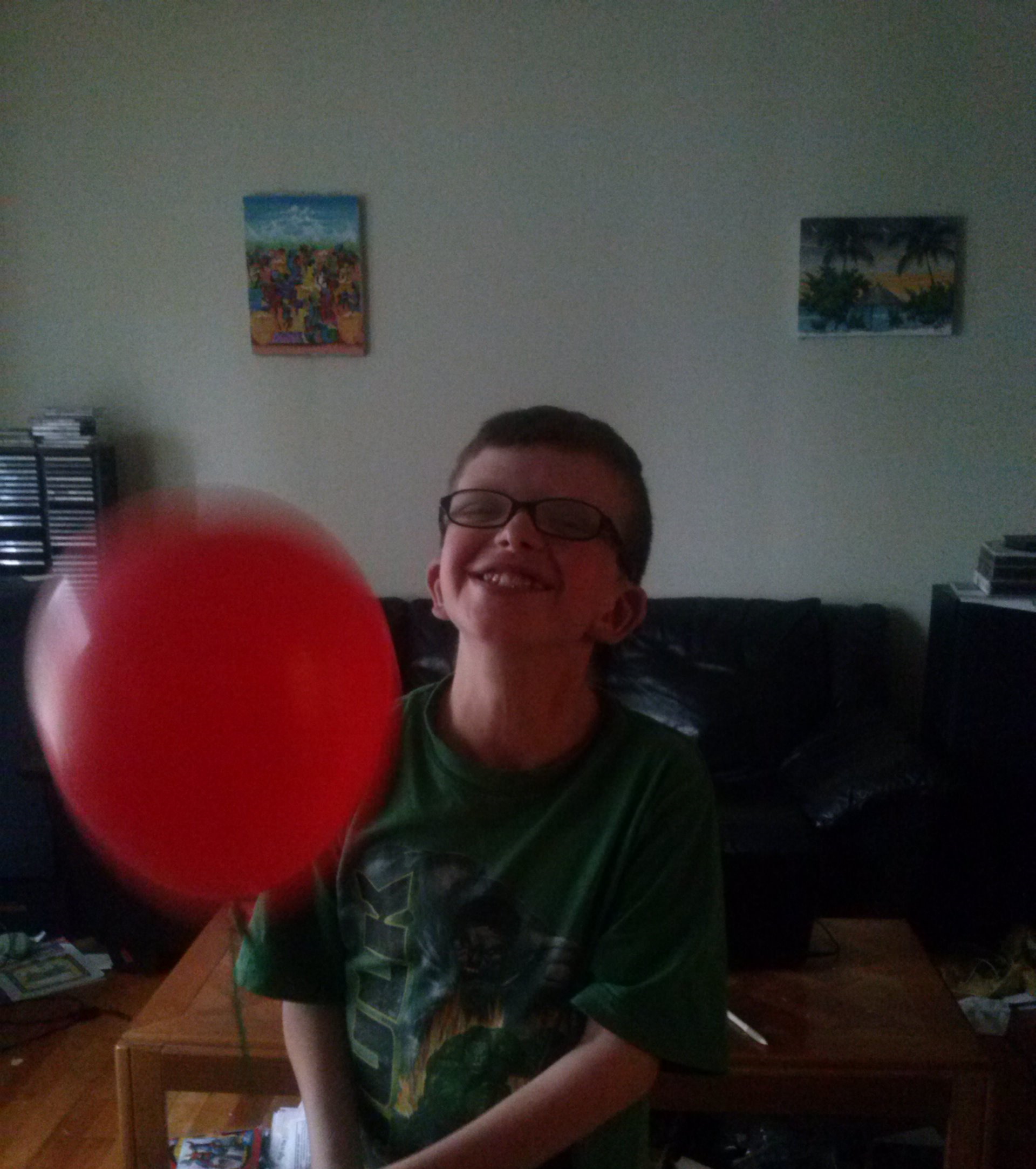
Alex balloon

My A to Z theme concerns the joys and challenges of being the hearing mother of my Deaf son, Alex. To learn more about his beginnings in life, click here to go to my first A to Z entry.


39 Comments

Hearing world – #AtoZ Challenge

Deaf people have to survive in a hearing world. This is a fact. If there are such things as Deaf stores, and Deaf hospitals, I don’t know of them. There are, of course, Deaf people working in public service positions–my bank has a Deaf teller–but it’s uncommon.

As the parent of a Deaf child who is growing up and will one day, hopefully, be independent, the fact that my son will out alone in a society that views him as different, is a concern for me. Alex is at a disadvantage, having not grown up exposed to his first language as most children are. Immersion into American Sign Language didn’t happen, and so by the time he reached the Deaf school that he now attends, he was years behind many of his peers. But at the same time he has an advantage. He’s already learned how to communicate, somewhat, with the hearing. He has an innate understanding that he needs to demonstrate what he wants without being able to verbalize. He has adapted.

On the flip side, I remember a story that my ASL teacher told us when I was in my third year of classes. He was the only Deaf member of his family. He told us of family gatherings and dinners when he was a child and through his teenage years when he would sit and eat, and no one would talk to him. They were all busy yammering away; he said he felt completely isolated. Consequently, he moved away–right out of the province–and had stayed away since. I can’t say he hated his family, but he seemed extremely bitter.

I fear this happening to Alex. I try my best to translate for him during dinners, but it’s difficult. First, keeping up with the conversation in ASL when my vocabulary isn’t up to par, and second, signing with a knife and fork in my hands. Despite this, he seems well-adjusted. I do what I can to make sure he’s included, at least in discussions that concern him. It’s more difficult when I’m talking with someone about something that doesn’t – with hearing kids, boring adult talk is naturally tuned out. Again, he’s at a disadvantage – if he was part of a Deaf family, he’d know to ignore it without having to be told it doesn’t concern him. On my end, I’m constantly saying to him, “It’s nothing.” I can only hope that he can tell by my body language and facial expression that I’m being sincere, and not just dismissing him as unimportant.

Alex, 2009. His usual charming self.

My A to Z theme concerns the joys and challenges of being the hearing mother of my Deaf son, Alex. To learn more about his beginnings in life, click here to go to my first A to Z entry.