I didn’t sign up for the A to Z challenge (for the first time in five years) because I didn’t want to put pressure on myself to post every day. I know I’m going to be busy later on in the month but now? Now I’m itching to write something. Anything.
All the writers’ groups I’m in on Facebook are filled with posts about Camp NaNoWriMo. They’re happily discussing their works in progress and me?
I swear, the itch to write is worse than a mosquito bite that you can’t leave alone. It’s more a mosquito bite that’s so far embedded in your chest that it’s like the damned bug is buzzing around in your esophagus, and you can’t even swat it out because you can’t reach it.
That’s the best I can come up with.
So, can I write a post that starts with “B” tomorrow and not get kicked off the webz? Can I? Can I?
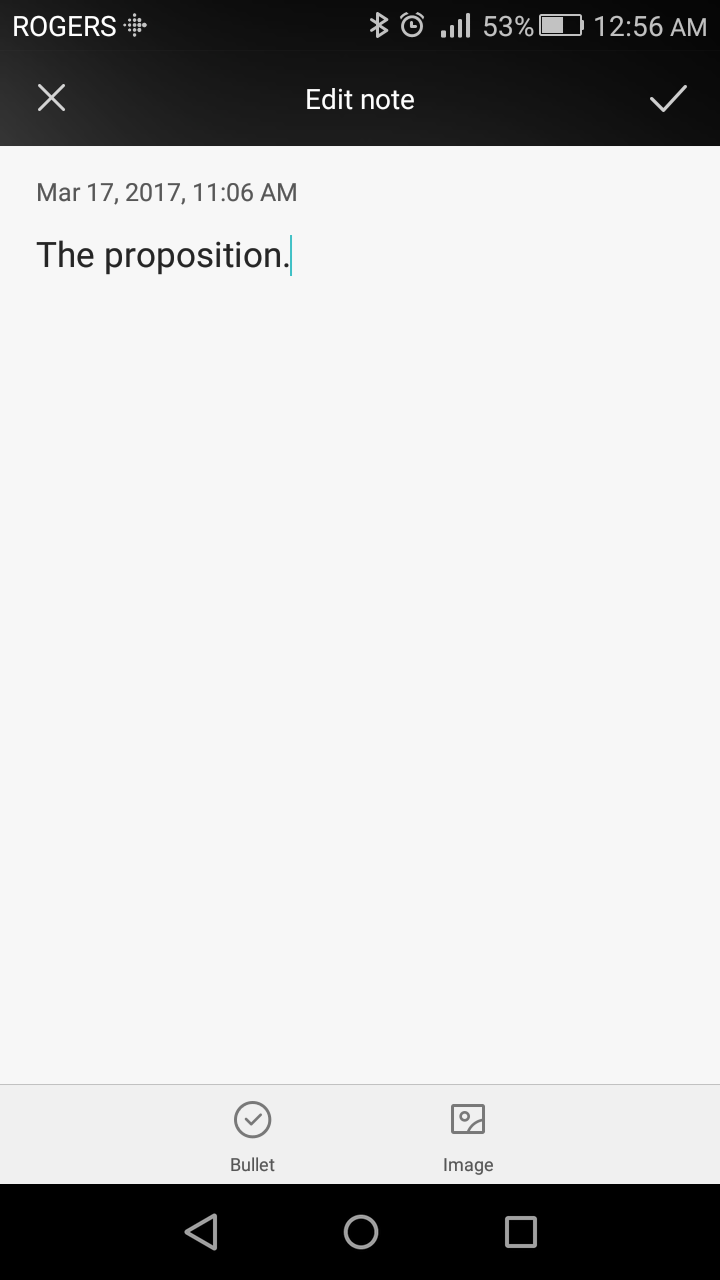
Once in a while I get a brilliant idea for a story–something that’s so mind-boggling, that I just KNOW it’s best-selling-novel material. I’ll be so excited that there’s NO WAY I’m going to forget this idea, but I write myself a little note, just to make sure.
Here’s one example, that’s been on my phone for almost a year:
I have no freakin’ clue what the story was going to be about.
If you would like to participate in this prompt, feel free to use the “One-Liner Wednesday” title in your post, and if you do, you can ping back here to help your blog get more exposure. To execute a pingback, just copy the URL in the address bar on this post, and paste it somewhere in the body of your post. Your link will show up in the comments below. Please ensure that the One-Liner Wednesday you’re pinging back to is this week’s! Otherwise, no one will likely see it but me.
NOTE: Pingbacks only work from WordPress sites. If you’re self-hosted or are participating from another host, like Blogger, please leave a link to your post in the comments below.
As with Stream of Consciousness Saturday (SoCS), if you see a pingback from someone else in my comment section, click and have a read. It’s bound to be short and sweet.
Unlike SoCS, this is not a prompt so there’s no need to stick to the same “theme.”
The rules that I’ve made for myself (but don’t always follow) for “One-Liner Wednesday” are:
1. Make it one sentence.
2. Try to make it either funny or inspirational.
3. Use our unique tag #1linerWeds.
4. Add our very cool badge to your post for extra exposure!
As a writer, I spend a lot of time contemplating the stories that form in my head. At my worst, during my most creative spells, my mind blocks out everything going on around me. I become consumed, beyond contemplation, in my own world. I get to the point where I’m not telling the stories anymore, rather the stories are telling me what is and isn’t true. I’m not imagining; I’m listening.
So it’s rather a shock when my beta readers tell me I should take out a scene because it makes them uncomfortable. I don’t blame the readers; I appreciate their input and I understand their discomfort. But I’ve lost two betas at the same spot in the second book in my series, “The Great Dagmaru,” in the last week, and that makes me wonder if they’re not right. My guilty conscience for making people uncomfortable is warring with the writer in me who says the scene in question IS part of the story. It’s what happened. So changing it or removing it comes to the same result: compromising the story’s truth.
I have a feeling that if I leave the scene in, it’s either going to make or break my entire series. The readers who realized it needed to be in there enjoyed it (or tolerated it) because it made them feel uncomfortable – it’s what it’s meant to do. Those who hated it may end up hating me. Should I be hoping at this point that it will push enough buttons, whether positive or negative, to make the book go viral? On the other hand, maybe it’s not all that bad, in the hands of the right audience. Speaking of which, note to all the readers who thought The Magician’s Curse should have been categorized as “Young Adult”: the second book will prove to be distinctly “Adult.”
Stay true to your story and publish without fear, says most of me: Write to please people with a story fit for Hollywood, the part of me that wants to bow to the more sensitive readers says.
What I want to write about today is and isn’t pants; it’s panties. I’ll start by explaining how I got from one to the other: in a word, English. In North America, pants are the things we walk around in that everyone sees. In the UK pants are trousers, and underwear are pants. I honestly wish we could call them that here too, even though I hate the word “trousers.”
But you know what word I hate even more? “Panties.” I use it for lack of a better word when I write fiction–underwear seems such a bulky word. One that conjures, in my mind, visions of undergarments that cover from the lowest part of the butt cheek to the waist. To have the hero of one of my stories strip his lady love of everything but a pair of those would quickly transform the sexiest scene into either a comedy or worse, something that would make me gag.
I didn’t grow up calling them panties, which may be why I’m so adverse to the word. What do you think? Is “panties” as distasteful for you as it is for me? Do you have a better word?
I’ve considered having all my characters go commando, just so I don’t have to deal with it at all.
When I wrote my very first novel in 2004 (I think), Trixie In a Box, about a woman stuck in an elevator in a deserted building over a long weekend, I had no idea what genre to place it in. Which is partially why I still haven’t published it. If it was a movie, it would be a drama. While Trixie is enclosed in her dark metal box, her family goes through a crisis and barely notices she’s missing. This conundrum has led me to much contemplation on the meaning of the word “drama.” Why it’s not recognized and hugely popular as a literary genre is beyond me.
If you think about it, drama in movies is really simply a slice of ordinary life. Sure, something significant happens within that hour and a half, but things happen in life all the time. Unless we’re in an extended rut, we tend to go from one drama to the next. The most popular recent use of “drama” is related to angst. Often teenage angst; a negative connotation that’s made the word almost cringe-worthy.
Here’s Merriam-Webster’s definition as it relates to life rather than theatre:
3 a: a state, situation, or series of events involving interesting or intense conflict of forces
the drama of the past week
dealing with some family drama
b: dramatic state, effect, or quality
the drama of the courtroom proceedings
So what to do with Trixie? It will take some major up-to-snuff editing to elevate (pun not intended) her to literary fiction. I do hope she’ll see the light of day (okay, that one was a little bit intended) eventually.
Normally, I’m a very positive human being. I like to find the bright side in everything, if there’s a bright side to find. Most of the time when I find something good out of something very very bad, I keep my mouth shut, because whatever it is I’ve found would seem insensitive. I remember once making the mistake of saying to someone whose car had been damaged in an accident that at least the guy in the body shop made some money … You can see by this how far I stretch.
But, in contrast, sometimes my imagination takes me to worst-case scenarios where even I can’t find something good. And that’s actually where my stories come from.
Imagine, for instance, something terrible happening (no one dies!) that affects everyone. All the banks close just before Christmas, for example. No one can do their shopping, and only those with cash can buy groceries. No good can possibly come of this, except, maybe for a villain!
I often write dark stories, and the strangest thing about it is that they’re driven by my optimism. I’ve wondered for years where my odd tendency for writing horror comes from. I think I just figured it out.
Thanks, Stream of Consciousness Saturday Sunday. 😛
Oh, and speaking of SoCS, I did write something on my fiction blog last night, for the first time in ages. Click here to read it.
Being a writer, I’ve read thousands of articles and opinions on how we typically come up with the characters who appear in our fiction. Is there a typical way? Probably not, but being as this is stream of consciousness and I stuck that damned rule in there to say we can’t edit, … that’s all she wrote.
Anyhoo, back to the topic of characters. One of the phrases I read a lot is “giving birth to characters.” I can’t say that I do that. “Giving birth,” to me, implies that they’re brand new shells of people who rely on me to fill them up with experiences, emotions, ways of speaking, and things they’re likely to do and ways they’re likely to react at any given moment. For me, characters appear as already-formed beings. I don’t give birth to them as much as I discover them.
One of the ways I know this–one of the main ways I know this–is when they show me their accents. In this alone I can tell where they come from, whether or not they have a lot of money, their age, their demeanor. I suppose it’s not necessarily as much “accent” as way of talking. Inflection, grammar, whether or not they use a lot of cliches. That sort of stuff.
It’s not as though I have them hanging around in my head all the time. If they did, I wouldn’t get a thought to myself. Nah, they come and go. You’ll see them in my “Second Seat” series. Come to think of it, it’s almost as though I have a bus inside my head …
When I started writing books, I thought, Bah! This is easy! And it kind of was for me. It was like writing a short story but not stopping at the short part. It was like writing a really, really long short story. Not really rocket science.
Little did I know the rocket science part was coming.
It started with the editing. First I had to figure out how to do that, so I read a gazillion articles, blog posts, advice columns, took courses … you name it, I did it. I still often consult the wise advice of others. That kind of learning never stops if you know what’s good for your novels. Then, finally, I decided after much intense deliberation to self-publish. I was told I’d have to market myself even if I went with a traditional publisher, so why not do it and keep the royalties to myself? So off I went on a new learning curve.
Articles, blog posts, advice columns … I haven’t taken the courses yet, but I’d be tempted if I wasn’t still learning the editing stuff. Yet what I read in these marketing columns, over and over, is that the most important part of marketing is a newsletter. Which brings me to today.
And why I’m nervous.
I have a newsletter. So far I’m the only one who’s signed up, but I have a “welcome” letter all ready to go for the next person who does. The next bunch of people, in fact. This is brand new territory for me and I’m kind of beside myself, because if you sign up and you read it–or worse, if you don’t read it–we can’t talk about it because it’s a one-way street.
I’m actually more nervous than I was when I released my first novel. Crazy, isn’t it? Ah well, here we go. Worst case scenario, I’ll close up shop and go back to the easy stuff: writing novels.
July 19th, 2013: My trip to Kingston was interesting indeed. With so many strange goings-on, I can’t help but wonder if I somehow ended up in my own novel. Without giving too much away, this is how it went:
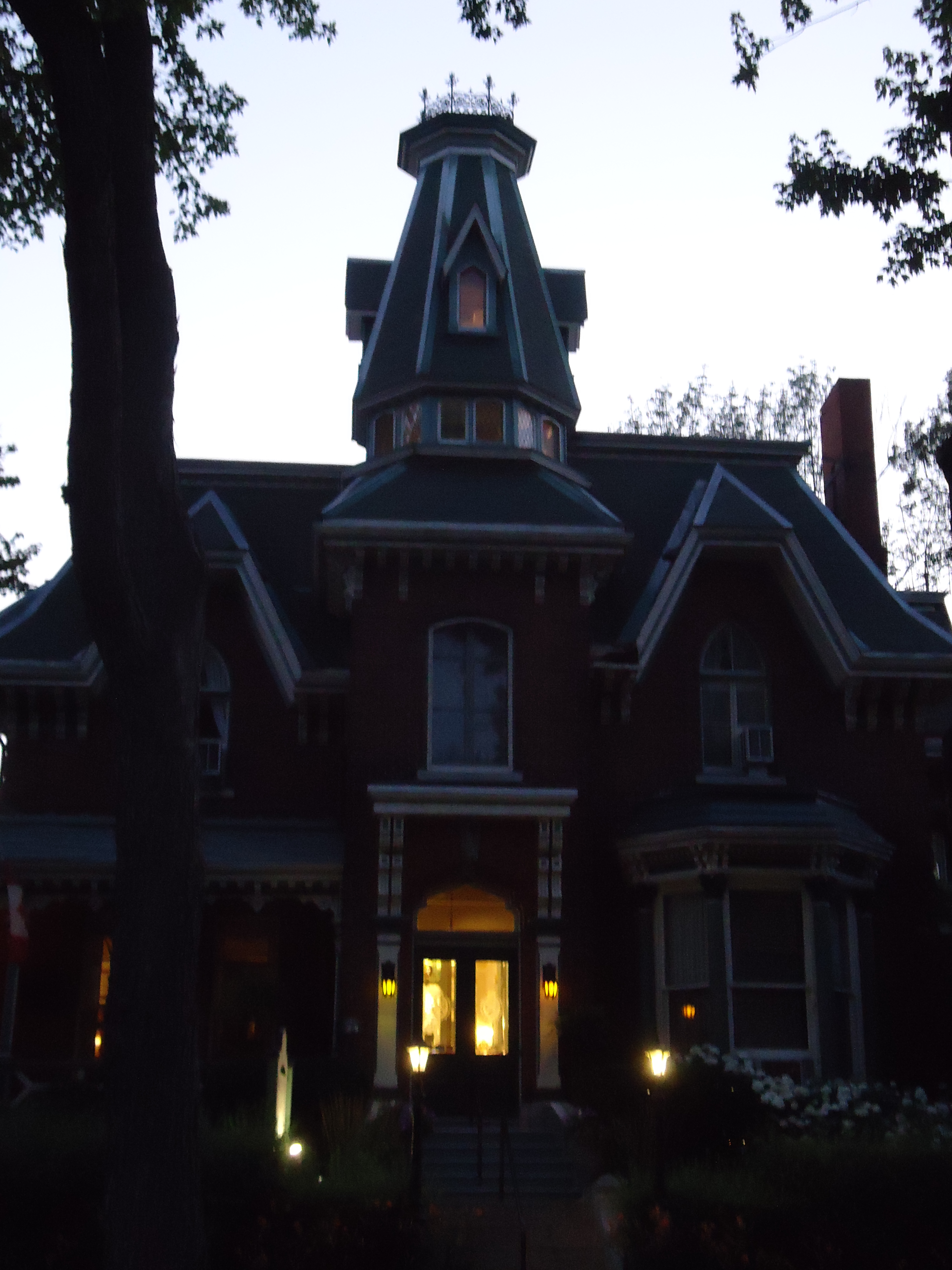
The Hochelaga Inn was much as I expected. Built in 1879, it has been well-preserved not only in its physical appearance, but for its ambiance as well.
A Welcoming Prayer
Peace and rest, however, although perhaps wished upon me by the Management and Staff, were not what the Inn itself had in store.
Having not a great deal of money, but wishing to take an extended weekend away, I booked the cheapest room in the Inn for the first two nights, (Saturday and Sunday) and the Tower room–the most expensive–for one night (Monday).
My first night didn’t include much sleep. Three times during the course of my slumber, I was awoken by the fire alarm, which was situated on the ceiling beside a spinning fan, for no apparent reason. When I asked about it at reception the next morning, because I thought there might have been a problem in another room, they said they had no idea what had happened. Unfortunately, I was told, the Tower room was booked for that night, otherwise they’d have moved me in there early. So I gave back my room key with an assurance that I would be moved to another room for my second night at no extra cost.
The conversation between the two ladies I had spoken to at the desk, overheard after I walked away, went something like this:
“Her fire alarm went off three times last night.”
“Wooooo …” in a ghostly voice.
Okey dokey then.
Later, when I arrived back at the Inn after spending a lovely day wandering around Kingston and getting burned to a potato chip by the sun, I was handed the key for the Tower room.
“We were able to move you up there a day early,” the lady said without further explanation.
The house wants me in the Tower, I thought.
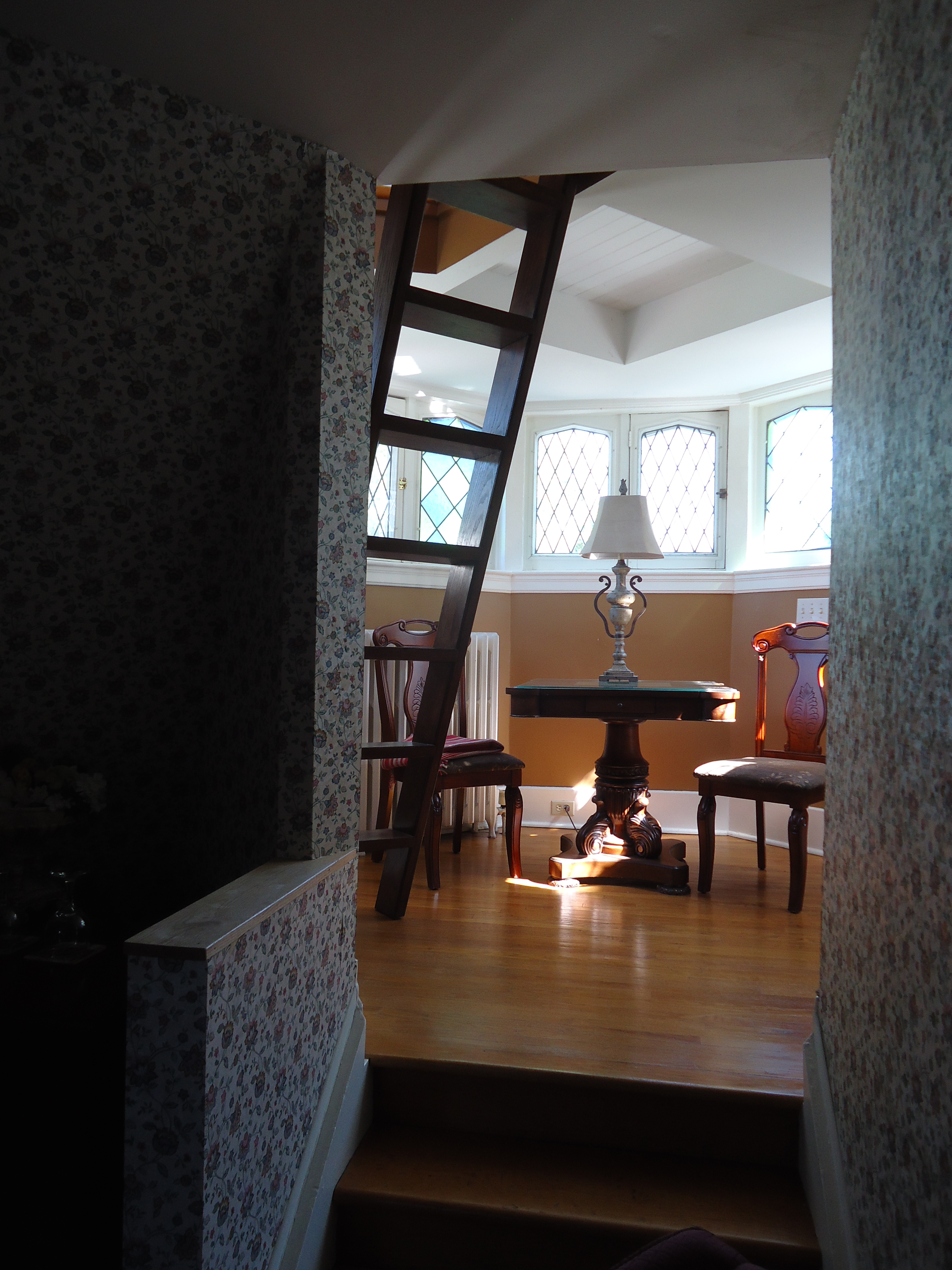
I happily I went up to my room to take a few pictures before dark.
The lower part of the tower.
The view from the top
It was a long day and I didn’t feel like doing much, so I sat on the bed with my feet up and watched a movie on my laptop. I didn’t bother to turn on the lights, and by half-way through the movie (The Brave, with and by Johnny Depp if you’re wondering) it was dark. That was when my friend decided to come along. I didn’t take a picture of my friend, and in fact I’m quite proud of myself for not throwing my laptop across the room. Let’s just say he had eight legs and appeared to be the size of Jaws as he scurried across my screen.
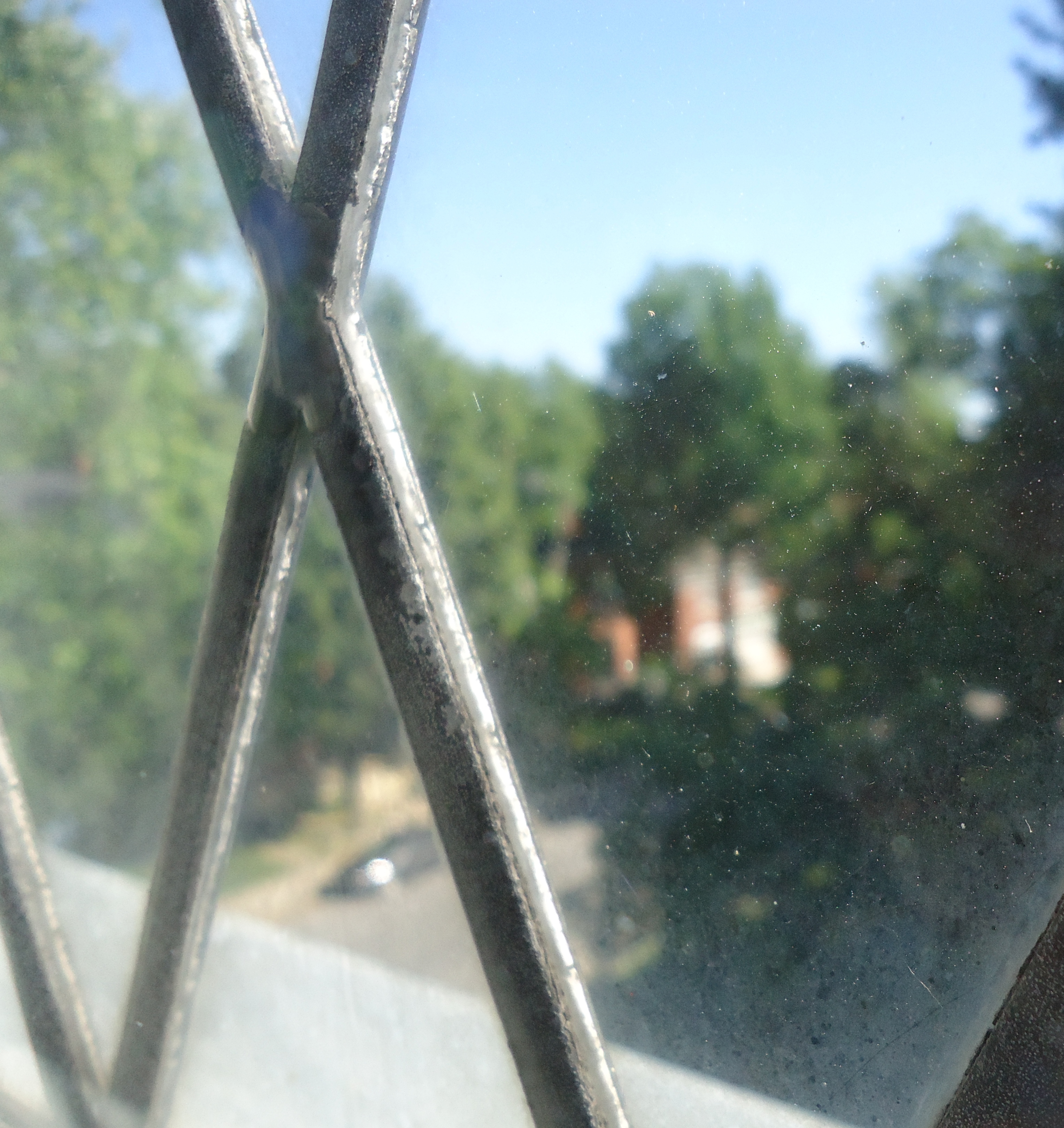
My second night didn’t include much sleep either. I think my camera catches quite well the state my eyes were in by Monday morning:
A lovely blurred view from the lower tower window
I spent most of Monday driving around town. I went to the VIA Rail station, where my two main characters disembark after having met on the train, and I was able to record many small details such as the waiting room seat colours and the fact that there are sliding glass doors on both the back and front. I drove from there to where my story is set–where I imagine the house to be–to see how long the journey would take, as well as noting different things they might see on the way.
When I got back ‘home,’ the first thing I did was look for the spider. There was no sign of him whatsoever.
Yay! I thought. I’m going to get a good night’s sleep!
HA!
So I was downstairs talking to the lady at reception again after having spent a few minutes poring over a framed blueprint of the Inn, from 1920 when they were hooking up the electricity. The house had changed quite a bit, and we were having a lovely discussion about where the rooms were and the staircase that wasn’t there any more etc.. when she mentioned the ghost.
“There’s a ghost here?” I asked, my eyes like saucers, I’m sure.
From there I went to a bar. Okay, I went to a restaurant. But must say I indulged just a little. As it turned out, I was sitting on the patio waiting for my bill when a strange looking man wearing a black cape and holding a lantern (click on the Haunted Walk link above for a visual) exited the building that housed the restaurant. He stopped and stood not six feet away, waiting. It took me a few seconds to realize he was the tour guide for The Haunted Walk. (Like I said, I’d had a few.) So I thought it might be fun to talk to him.
“Excuse me, are you guiding the Haunted Walk tonight?” (All right, all right. Maybe I was sloshed.)
“Yes,” he replied.
“I’m staying at one of the places on your tour: The Hochelaga.”
“Yes, that is one of the places we visit,” he said politely.
“Would you like me to put a sheet over my head and stand at the window in the Tower?”
I thought he was going to blow a gasket.
“YES!” he exclaimed, all but jumping up and down in excitement. “The people would love that!”
So guess what I did?
At dusk. I turned on the lights in the Tower so they would glow.
After the people left (they actually pointed at me, standing at the very top window at the front, looking down) I turned on the lights and went outside to take a picture of the most incredible Hochelaga Inn.
And that night? I slept like a baby knowing the ghost was safely tucked in bed.
Spooky, no?
To this day the spirit of the place haunts me. My characters, whose footsteps I was privileged enough to walk in, are with me in a way they weren’t before. The sights I saw are imprinted on my vision, deep and immovable. I’m lucky to have been able to visit the wondrous settings from which I was able to tell my story.
If you’d like to visit The Hochelaga Inn, click here for their website. I highly recommend it for its ambiance, its breakfast, and for the experience of sleeping in such a beautiful old Victorian mansion.
My Gothic paranormal romance, The Magician’s Curse, which is set in Kingston and features a house that is inspired by The Hochelaga Inn, is available on Kindle, Kobo, and in paperback on Amazon, as well as on the shelf in the Novel Idea Bookstore at 156 Princess Street in Kingston.
I’ve come to the conclusion that writing a series of books rather than a standalone is harder when you’re a pantser. A pantser, if you’re not familiar with the term, is a writer who writes by the seat of his or her pants, as opposed to a plotter, who plots the entire story out ahead of time. If I could just plot out where my characters are going to go after book three, I would know if their life beyond it was worth writing about. Because let’s face it, no one wants to read a book about people getting up and going to work every day, coming home, cooking dinner, watching TV and going to bed, ad nauseam. It’s bad enough that most of us do just that in real life.
Therefore, I can only guess whether my series will be a trilogy or if it will go on.
Don’t get me wrong – I love pantsing. Sometimes I’ll be happily typing along, minding my own business (because I don’t make up my stories. I just pluck them out of mid-air and transcribe them) and suddenly one of my characters will say something that completely blows me out of the water. Like, I had no idea it was coming. It’s by far the best part of writing. When you’re reading a book and you get hit by a sudden revelation, you can bet that there’s a good possibility the author was struck at the same point in the story with that same gong. What’s not to love about being hit by a gong? (I do enjoy stream of consciousness writing.)
If I was to guess right now, I’d say it’s going to be a trilogy. Yet I know I’m going to miss my characters so much that I’m not going to want to stop writing. Will they get up to more adventures? I guess they could. We all do, once in a while, right? If we didn’t, our boring day-in-day-out existences would drive us to eventually seek something more anyway.
Speaking of adventures, I’ve updated and edited an old post. It has more pictures now, as well as a few more links. I can only guess whether or not it will show up in your email if you follow me that way. I’m guessing it will, if you weren’t following me in July of 2013 when it was first posted. I urge you to read it if you haven’t already: it’s one of my best. Even if you have already read it, check out the new pictures. I’ll repost it in an hour or so. It’s entitled “A Haunted Visitation.”
While you’re here, take a good look at the badge, for it may be the last week in which it’s featured! The contest is on right now for a new SoCS badge design. We have five entries already, which means there are only five slots left open. Click the following link to read more about it, see the entries so far, and enter the contest yourself: https://lindaghill.com/2017/08/08/the-4th-annual-socs-badge-design-contest/







 lindaghill.com