Twins. Part of the plot in my NaNoWriMo project required a case of mistaken identity, so instead of having one protagonist, I’m writing one and a half. I call the twins “one and a half” protagonists because I’m writing in the first person – so I’m getting all of what one of them thinks and only half of what the other does. They’re both good guys, Marcel and Max are. Decent men from a good family – very much the same in many ways.
As usual, something happened in real life which made me contemplate the differences between siblings. In this case it was a conversation with the lady who manages the dry cleaner on my paper route. She has two granddaughters who she loves to talk about. She was telling me how unalike they are, even though they’re very close in age. This is a subject (among many) that has always fascinated me, being an only child. My own children didn’t grow up as siblings usually do, since they all have such physical differences, so it’s something I must study from a distance.
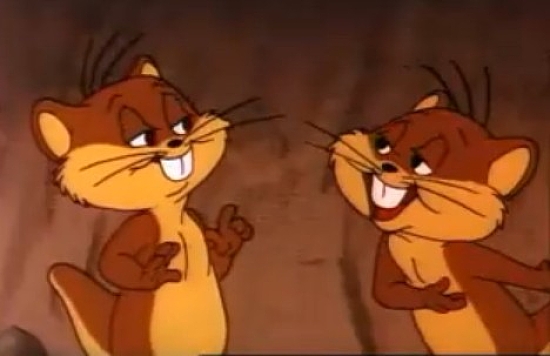
The difficulty I’m experiencing in my novel is that the twins, Marcel and Max, sound the same when they speak. It makes sense to me that they should, but they end up coming out like these guys:
Not all that polite mind you, but they speak exactly alike.
Once NaNo is done and I can put some thought into it, I’ll work on finding something unique about the two, which will come out in their speech. But in the meantime, I’m wondering what about their natures, and not their nurture, can help my readers to tell them apart.
Have you ever written siblings and come across this problem? Let’s learn from each other!
I’ve been seriously thinking about how much my own tastes influence my fiction. The other day, my characters were in a restaurant and I purposely made them order something I, personally, wouldn’t eat.
It occurred to me that maybe I’m thinking about this too much – micromanaging my story. But the fact is, they’ve gotta eat. And I find it boring and not really credible that they’d like ALL the same things I do. If for no other reason than every character in every story I ever write always eats the same group of foods, I feel like I have to change it up once in a while.
Is this something you’ve put any thought to? If you’re a vegetarian, do you ever have your characters eating a nice juicy steak?
How else do your characters not reflect your tastes? (Human characters, that is.)
Write what you know; write what you know; yes, yes, okay we get it already. But have you ever wanted to write who you know? Fictionally that is.
When I write, I write characters. Plots in my stories, are secondary. I take, for instance, a scenario, ask ‘what if?’ and off I go. Once I have a character in place, they decide what happens in the circumstance I put them in.
I know a few people very well. Family, friends – I can’t help but know them. The people I don’t know very well, I study. I watch the way their expressions change when they talk about certain topics that they love or which scare them… you get the picture, right?
But there’s that saying again. That rule. Write what you know.
Now say, for instance, I was to write about someone I adore. They probably wouldn’t mind. They’d be able to hold my bestseller up high and say, ‘This is about me!’ and they’d be proud to do it. But what if I wrote about someone who I don’t respect? Or someone whose personality is less than scrupulous? I wouldn’t use their real name, of course. And the story would not be the one they lived in real life. But they’d know. And I’d know that they knew. And then I’d have to wonder; are they planning to do something devious to smite me? After all, they aren’t the most the most pleasant person to deal with in the first place. How far will they go?
Write what you know. I know very little about ‘things,’ but I know a lot about people. About characters and what makes people tick.
Have you ever ‘written’ someone you know, fictionally? How would you feel if someone ‘wrote’ you?
So yesterday I was sitting in an unnamed coffee shop
with my friend John, and we were chatting over lunch. A couple of twentysomethings sat at the table next to us and proceeded to scratch their lottery tickets.
When John and I got up to leave, he commented that he needed his jacket cleaned soon – he works in the automotive-type industry and it is covered in grease. The man at the next table said, simply, “Baby shampoo.” We both looked at him and he explained: “You can get grease off clothes with baby shampoo. Oh and it costs $300 to ship a car from Vancouver to Toronto by train.” The latter was something John and I had been discussing earlier on in the conversation. We both thanked him for the information, like the polite Canadians we are, and left.
Since then I have thought about all the things we could have been talking about, and one conversation I had years ago with my ex sticks out in my memory.
Being a writer, sometimes I talk about my characters as though they’re real people. Just imagine what the eavesdropping couple would have made of this:
Me: So it turns out Helen is fooling around on Frank.
John: That bitch!
Me: I know, right? But I don’t want him to find out.
John: Because…
Me: Well, you know. He’s in jail. There’s just so much a guy can take.
John: True.
Me: So I’ve decided to kill her.
John: Huh. How?
Me: I can’t decide. I was hoping you’d help.
John: I’ll do what I can.
Me: I mean, I’ve thought about drowning her in the bathtub.
John: That’s a good one.
Me: Or I could just drop the hairdryer in with her.
John: And fry her…
Me: I don’t know though. It seems too convenient.
John: How about killing her in a car accident?
Me: She doesn’t drive, so that would mean killing someone else as well.
John: How about Martha!
Me: YES! Great idea.
You’ve got to wonder if the couple at the next table would have been quite as ready to make suggestions…
Every once in a while I feel the need to reach out to my fellow writers, and I consider it a gift to have, here at WordPress, so many friends who are sailing along with me in this boat. Up until I began my blog, writing was a solitary endeavour if ever there was one.
So, I’m here once again to see if anyone else out there shares my experience.
Inspiration comes to me from everywhere: from an unusual sight; from people I see when I’m out; from music, art… you name it. But only once in my life have I found someone who could inspire me to write an entire novel. His face, his movements, his physique, his voice – there is nothing about him which doesn’t inspire me. And without fail, every time I see him I am compelled to write the character I have found through him.
I can’t imagine I’m the only one who has felt this seemingly unlimited amount of inspiration from a single person or thing.
So tell me. What has been your boundless inspiration in the past? What, or who, is responsible for giving you the excitement necessary to write tirelessly, and on occasion, effortlessly?
I wrote a flash fiction a little while ago called Puppet Master, and it got me to thinking about the characters I write. In a sense, I imagine them into being, but as they grow I can’t help but wonder if they were all my imagination. Perhaps they were always there, and I simply uncovered them.
When I ‘create’ a character, I take a single aspect of their personality. I then add a few details of their past, mix in a number of ‘what ifs’, and shove them into a cooker to see how they’ll handle it, suddenly I’m left with a complete person who evokes feelings of empathy, love, hatred, or what have you. The point is, they become real to me, and, I hope, my readers. After all, what we care about becomes real to us, does it not? Attachment to characters in a well written story can cause us to mourn when the story is over.
Going back to the Puppet Master story, I don’t feel that this is what I am. I may have the ultimate control over where my characters end up, but it is their own strengths and limitations which determines whether they will succeed or fail, live or die, as long as I remain true to them. Not to stay truthful when I write is, for me, a sin. That again is another argument in favour of the fact that they exist.
I have read many times about authors who feel that they are ‘God’ over their characters. Personally, if I felt that way I don’t think I’d be doing it right. My role is to simply make my characters known to as many people as I’m able. And if they came out of the oven delicious enough, people might even keep them alive through fan fiction. 😉
According to a blog post I read here at Brainsnorts the most important part about opening a novel is the first four sentences. So I decided to go to my bookshelf and pick up four novels at random and check it out, to see if there’s anything the first few sentences have in common in each book. These were my selections:
Standing Stones – The Best stories of John Metcalf
“Single Gents Only” (a short story)
After David had again wrested the heavy suitcase from his father’s obstinately polite grip and after he’d bought the ticket and assured his mother he wouldn’t lose it, the three of them stood in the echoing booking hall of the railway station. His mother was wearing a hat that looked like a pink felt Christmas pudding.
David knew that they appeared to others as obvious characters from a church-basement play. His father was trying to project affability or benevolence by moving his head in an almost imperceptible nodding motion while gazing with seeming approval at a Bovril advertisement.
This seems to me like a promising story. There is movement in it in the form of the fact that these people are going somewhere. The fact that the son takes the suitcase from his father tells me that he’s an adult. I want to know where they’re going. The description is good enough that I can imagine the scene easily.
The Marks of Cain by Tom Knox
Simon Quinn was listening to a young man describe how he’d sliced off his own thumb.
“And that,” said the man, “was the beginning of the end. I mean, cutting off your thumb, with a knife, that’s not nothing, is it? That’s serious shit. Cutting your own thumb off. Fucked my bowling.”
Okay, that was more than four sentences, but they were short ones. Shoot me. This opening is interesting. It doesn’t have much in the area of description, but how much description do we need? We can easily imagine the blood involved. Who is the man to Simon and why is he listening to such a horrific story? I want to know more.
It wasn’t a very likely place for disappearances, at least at first glance. Mrs. Baird’s was like a thousand other Highland bed-and-breakfast establishments in 1945; clean and quiet, with fading floral wallpaper, gleaming floors, and a coin-operated hot-water geyser in the lavatory. Mrs. Baird herself was squat and easygoing, and made no objection to Frank lining her tiny rose-sprigged parlor with the dozens of books and paper with which he always traveled.
I met Mrs. Baird in the front hall on my way out.
This opens very nicely indeed. The description is lush and from it we gather that Mrs. Baird is not going to be a central character, as we don’t get her first name from the narrator. Best of all, the very first sentence tells us that something mysterious will happen! Again, I want to read more!
I stare up through gaps in the sea-grass parasol at the bluest of skies, summer blue, Mediterranean blue, with a contented sigh. Christian is beside me, stretched out on a sun lounge. My husband – my hot, beautiful husband, shirtless and in cut-off jeans – is reading a book predicting the collapse of the Western banking system. By all accounts, it’s a page-turner.
Here we have two shades of blue and a good-looking man reading a boring book.
So. What do three of these openings have in common? Amazing descriptiveness, movement, action and/or gore and some element which makes us want to know more. What’s going to happen? Who are these people? Why are they; 1. in a train station; 2. cutting off their own thumbs; 3. staying in a place where someone is going to disappear?
And number 4? It tells us what not to do. By all accounts, it’s a page-turner. 😉
Thank you again to Brainsnorts for the idea for this post!
I was having a discussion with a friend on Facebook this morning about why a real human being can feel sadness over a fictional character. Another of his friends stated that it’s because the writer has done a good job. But is it really only that?
When I create a character, the first thing I come up with is a mental image. With that image comes nuances in dress, movement and speech patterns. From there, especially from the speech patterns, I begin to see where they live, how they grew up and what brought them to the place where I insert them into a story. With all this information they take on a life of their own and from there on in, I become more of a spectator in their world than the person directing them. I may know where they will eventually end up, but how they get there depends entirely on how their life has evolved to put them in my story in the first place.
I wish I could remember where I read it, (and if you know or even better if someone reading this was the one who said it first PLEASE take credit for it!) but something that affected me profoundly was the statement that, (paraphrasing) “if the characters I create become real, then I feel very bad for what I put them through in my story.” I do think the characters I create have an existence somewhere in the world. Call me crazy. But this very thing is what makes it possible to relate to them, and why a reader can be happy for them or grieve for them.
Getting back to my original point, I don’t entirely take credit for having done a good job when my readers feel for my characters. They tell my stories – I’m just along for the ride. They have, as I do, their own private thoughts, and their own private world.
For anyone disentranced with content (or lack thereof) of my blog lately (I’m busy finishing up a couple of courses and haven’t had the gray matter for much else) I’d like to remind you that I have a fiction blog here on which I have expended a few spare brain cells to write some amusing and/or dramatic short scenes.
Many of them are unrelated, so they need not be read in order. For your convenience however, I have put the names of the characters in the tags so you can find scenes containing them, should find one or two characters you connect with. My personal favourite is Drommen, a polite pervert who can’t seem to catch a break.
In recent weeks of perusing different WordPress sites, I have come across on a few occasions writers talking about character development and how they will sometimes watch people and make up stories for them. I do this often. I get endless enjoyment from watching people’s mannerisms and body language as they relate to others.
I remember one instance when a friend and I were sitting on a park bench at a local public rose garden. We had been resting in quiet companionship for some time, enjoying being outdoors near dusk listening to the birds sing and watching people stroll through the park. There was one family I vividly recall – at least I assumed they were a family – a mother, a father and a son who pulled up in a car across the street. They got out and entered the park gates. The boy, around eleven years old, ran ahead seeming happy to be there. The mother followed, her nose in the air enjoying the fresh fragrance of the roses in full bloom and the father lagged behind. Observing them, I leaned toward my friend and commented that the man didn’t look like he wanted to be there. Even though none of them spoke there was just something in the man’s gait, in the way he looked straight ahead and in the way he held his arms at his sides even though the pockets of his shorts gaped as if they were the natural resting place for his hands. As I watched him some more I leaned again to my friend and said, ‘I bet he’d rather be at home watching the baseball game on TV.’
I thought, what a character this man could make! Even if I were to tell his story from that moment on I could imagine that perhaps he was angry because he had a bet on the game and wanted to see his team win. Or that he loved watching baseball because it was the last thing he ever did with his own father before he died. Or that his own father would be disappointed in him, as he usually was as he grew up, because his father said he was a momma’s boy – just the same as his own son was growing up to be, having fun in a rose garden of all places! The boy should be watching the game with his dad, not asking to be driven all the way across town to look at roses with his mother!
If I were to make a character of this man whose world and thoughts I had surmised, I might not use any of these stories of his past in my tale. But knowing his past, and having a past already fitted to the reason for his present mannerisms I would know how he would react in any given situation. This, I find, is what gives a character dimension beyond the singular.
This recollection of mine has left me again to wonder just how private our thoughts and our world are. Yes, I might be (read: probably am) wrong in my imaginings of this man. But then again, in a perfect if sad conclusion to this episode, as my friend and I were walking home from the park, a car passed us with the very same family in it. The man was screaming at the top of his lungs at his family.
True story.
For Part 4 of Private Thoughts, Private World I decided to go off on a bit of a tangent due to a comment over in Ionia Martin’s blog a couple of days ago. The above is what I came up with.



 lindaghill.com