My A to Z theme concerns the joys and challenges of being the hearing mother of my Deaf son, Alex.
They say being deaf makes the eyesight better, but I had no idea what that meant until I took American Sign Language classes. Not hearing doesn’t improve the quality of a person’s eyesight – no one is going to from 20/200 (being able to only read the giant “E” at the top of an eye chart) to 20/20 because they are deafened. “Having better eyesight” simply means the brain works faster with visual stimulation. Take, for instance, the alphabet. Say it out loud as fast as you can possibly say it, and then consider a native signer can fingerspell it as fast as you can say it, and the average Deaf person can understand every letter as well as someone who hears can understand your speaking of it. Mindboggling, isn’t it? I used to come home from my three-hour classes once a week exhausted like I’ve never been exhausted before, and just because of the level of concentration required.
A to Z in ASL
What this means for me as a parent is that Alex doesn’t miss much. Even as a toddler, he was far more observant than the average kid. His attention to detail was such that, even before he knew what the letters of the alphabet were, he could match seventy-odd black VHS tapes by the labels together with their covers. It also means that he can easily pick up on facial cues.
Alex watches the show Ellen every day. He loves the way she dances and often mimics it. Sexy hip-grinding stuff? He’s on it. He’s also the size of a six-year-old, even though he’s fifteen, so he looks very cute doing it. This makes it very difficult for me to tell him to stop dancing like that in public. No matter what I sign, (stop, that’s rude, etc.) there’s a part of me that finds it funny. It’s easy for him to ignore what I’m saying with my hands, when the slightest twitch of an eyebrow tells him that he’s amusing me.
Believe me, you never want your teenagers to be able to read your mind. Mine can.
My A to Z theme concerns the joys and challenges of being the hearing mother of my Deaf son, Alex.
By now, if you’ve been following my A to Z posts, you might have noticed that sometimes I capitalize the word, “deaf,” and sometimes I don’t. It’s not as random as it might at first seem.
Being “deaf” with a small “d” refers to a physical condition. People who go deaf as they age will probably always be “deaf” as opposed to “Deaf.” “Deaf” with a capital “D” refers to someone who is part of the Deaf community. Those born into families who are already part of the community are considered “Deaf” from birth. Think of it like being born English, or African, and you’ll get the picture. Alex was born (or became shortly after birth) deaf. It wasn’t until he learned American Sign Language as his first language that he could be considered Deaf.
As his mother, again I was faced with a huge decision in regards to his deafness. He had an MRI to assess the extent and cause of his hearing loss, and it was determined that he would qualify for a cochlear implant*, which would allow him to hear, somewhat. It wouldn’t have cost me anything – he was deaf enough. I hadn’t realized that there was a chance I would have to pay for it. But that wasn’t my main concern anyway.
By the time he had his MRI, I had started taking formal American Sign Language classes at the Canadian Hearing Society in Ottawa, and he’d already started learning ASL. The Deaf community is tight-knit, with a culture that is unique to them. They tend to protect their culture with a fierceness that equals that of any other culture worldwide, and with reason. It is often misunderstood, as are the Deaf. I’ll get into that discussion on another day, however. My own focus was, of course, on my son, and I needed to decide whether or not he would be Deaf, or remain deaf.
It may seem like an obvious decision at first. I could have had my little hard-of-hearing child to myself, with his cochlear implant, and his tiny fingers that we still weren’t sure would ever be able to sign properly because of his low muscle tone. This last was related to both his Noonan Syndrome and the fact that he had spent eight months in a hospital bed instead of learning to play. Excellent reasoning to have a hearing child.
However, he’d been tube-fed from birth (and still is). On the surface this was completely unrelated, until an occupational therapist explained to me that, because he never learned to suck as an infant, the muscles in his mouth hadn’t developed properly. He would never learn to speak. His dad and I were still undecided when we went to see the surgeon who would perform the operation for the cochlear implant. We felt that it was important to know all the details involved in the procedure, so we could make an informed decision. The moment I heard the words, “five-hour operation,” and “drill a hole in his skull,” I threw up my hands and accepted that I would have a Deaf son. He’d been through enough.
To learn more about Alex’s beginnings in life, click here to go to my letter “A” post.
To learn more about cochlear implants, click here.
My A to Z theme concerns the joys and challenges of being the hearing mother of my Deaf son, Alex.
When I discovered Alex was Deaf, I knew I would have to learn Sign Language. However, there was no point starting a formal education too early. I knew from experience that if you don’t use a language, you lose it pretty quickly. So in lieu of classes, I devised a few logical signs of my own. I think the first I ever taught him, before he came home from the hospital at the age of eight months, was to let him know when I was leaving and coming right back. I simply held my index finger up as I walked out the door. When I was leaving for the evening, I waved goodbye so he would know the difference. It didn’t take long before he needed to know why people were exiting his room; he began to cry whenever a nurse left, even for a moment. “Just a second” was the first of many I would have to teach the nursing staff over the years. I found the signs for “mom” and “dad,” and a few others so I could add to both my vocabulary and that of the people caring for him in the hospital when I couldn’t be there myself.
Even now, fifteen years later, it’s necessary to teach the nursing staff how to sign whenever he stays in the hospital. And not just one nurse, because signing is usually the last thing they have time to relate to each other when they change shifts. They normally have 15 minutes to go through the medical history and changes of all the patients on the floor. If Alex is admitted for a few days, there’s a fair bit of staff rotation. When a hospital is close to a border, such as the Ontario/Quebec border in Canada, the staff are expected to be bilingual, yet there is no provision for teaching hospital staff Sign Language. At the very least, it should be mandatory to have a reference book on every floor. I had to buy one of my own and lend it, always hoping it would come back home after Alex’s stay.
For a child without diverse medical needs, this would only be a problem occasionally. For us, it’s an ongoing concern. I honestly don’t understand why it’s not mandatory to teach Sign in schools. If you follow my A to Z, you may agree with me by the time the end of April gets here that they should.
My A to Z theme concerns the joys and challenges of being the hearing mother of my Deaf son, Alex.
Though Sign Languages are as different as spoken languages worldwide, one thing is consistent; they all rely heavily on body language and facial expression. I’ll never forget the first time I was shown the sign for “not yet.” I actually laughed at my teacher, thinking he was joking. There was a mortifying moment. “Not yet” is exactly the same hand-sign as “late,” only with the tongue stuck out. (For a visual: http://www.lifeprint.com/asl101/pages-signs/n/not-yet.htm ) Anyway, by the time my son Alex started to learn American Sign Language I pretty much had my own face and body under control. Unless I’m angry, which is another story altogether. But when we go out in public, the results of people doing things without realizing it can range from amusing back to mortifying. For me. Alex has a blast.
For instance, almost any time I take him out, someone speaks to him. He’s a very engaging little boy. He smiles at people all the time. Invariably they ask him questions, and when they do, they smile back and usually nod their heads because they’re asking a positive question that they want him to agree to:
“Are you looking forward to going back to school?”
“Do you like Spiderman?” (Because he’s always either holding or wearing something to do with Spiderman.)
Alex sees them nod and smile and he nods back. He doesn’t need to hear the question. Which always puts me in the awkward position of having to decide whether or not to tell them he’s Deaf. Unless they ask him another question to which he would have to answer, for instance, “How old are you?” I don’t tell them. Why not, you ask?
People are embarrassed when they get caught talking to a Deaf person. It’s like they feel like they’ve suddenly made a fool of themselves simply by being friendly. When there comes a point at which I have to explain that the reason he’s not talking to them is he’s deaf, they either:
a) say, “Oh,” and walk away, pretending they didn’t speak to us in the first place;
b) say, “But he can lip-read, right?” because obviously he knew what they asked him. He answered the way they wanted him to! (I then say, “Yes, a little,” to ease their minds);
or c) whisper to me, “I’m sorry.” Depending on how I’m feeling on that particular day, I’ll either, say, “That’s okay, he’s just happy to interact,” or, “That’s okay,” and think to myself, Don’t feel guilty about it. It’s not your fault.
I sometimes wonder if, on some level, people know he has a good idea of what they’re thinking. Much of our body language is unconscious. We know we’re doing it, but we don’t always know when, or whether or not we’re controlling it well. And if that doesn’t make you feel self-conscious around a Deaf person, I don’t know what will.
Alex’s ability to read expressions gets embarrassing when he laughs at people. And he does, loudly and with great delight. Take, for instance, a scenario in which you’re out for dinner with someone you’re trying to impress, and you put something in your mouth that you discover you don’t like. You’re turning green at the gills but you’re trying to downplay it, so you grin and bear it while you continue to chew and swallow the offending piece of food. Meanwhile, at the next table, there’s a kid absolutely killing himself with laughter at the subtle expression you’re trying to cover up, while his mother, red in the face, attempts not to giggle at her offspring’s reaction.
All I can really do is try to distract him. I can’t say to the person, “He’s Deaf, and you look like you just put a live bug in your mouth.” It’s amazing how quickly people cease to be charmed by him in these situations. And they happen all the time. Of course I try to explain to Alex that it’s rude to laugh at people, but first, my vocabulary isn’t fantastic in Sign, so when he asks why, I’m at a loss. And second, how can I explain to him that he needs to suppress this wonderful ability to read subtleties that goes flying over the heads of most of the population? So I take it case-by-case and do my best to make everyone happy.
I knew Alex was going to have health issues when I had my first ultrasound, 10 weeks into gestation. He had, I was told, fluid around his heart and at the back of his neck. Down Syndrome was ruled out a few weeks later via amniocentesis. It wasn’t until he was born and transferred to the nearby Children’s Hospital of Eastern Ontario that he was diagnosed with the second most prevalent syndrome: Noonan Syndrome. To the geneticist it was obvious at first glance. Barrel-chested; low-set ears; thickness in the neck; and widely spaced, bright blue eyes. It was all there, on top of the multiple heart issues.
His prognosis was bad. Without surgery, his cardiologist told us his heart could no longer pump oxygen through his bloodstream. He would die within a year. The surgery itself came with a 50/50 chance of survival. It was a tough decision, yet an obvious choice. Just short of two months of age, he went to the operating room. About half-way through the procedure, the surgeon came in to let us know that Alex’s heart had stopped and he had lost all vital signs. They got him back after a few minutes by providing open-heart massage, but the surgeon said he would not resuscitate him again. It was time to close the suture and hope for the best. A couple of hours later we were told our little boy had survived.
The reason I go through this history when I’m here to talk about his deafness is, first, to explain why I reacted the way I did when I found out he couldn’t hear, and second, why he can’t hear. He was about four months old when I began to realize he wasn’t responding to noises. Since he was still in the hospital (he didn’t come home until he was eight months old), I had him tested right away. When the test proved he was profoundly deaf, I felt sad that he couldn’t hear me sing to him, and that he would never be quite like the rest of us, but hey – he was alive. Years later, I’m still realizing the impact of his difference in abilities, as you’ll see as the month goes on. Noonan Syndrome doesn’t include deafness as one of its genetic anomalies. The doctors told me it was likely the lapse in vital signs during the surgery which injured his brain. I had to wait to find out if he would have any other symptoms – as it turns out, I’ll probably never know.
It’s been a roller coaster of ups and downs, with oh so many laughs and challenges and opportunities to learn along the way. I hope you’ll enjoy reading about the ride.
Just before Alex finally came home (if I remember correctly, the weekend of the CHEO telethon in 2001 was his last weekend at the hospital) they filmed some of the inpatients to show at the end of the news. The baby at the end (2:24) is Alex.
Yes, I know, I’m a week late. My excuse is that it’s taken me this long to a) decide on my theme, and b) decide whether or not to incorporate the same theme on both of my blogs. Being the glutton for punishment I am, I’ve made up my mind to flog myself participate in the challenge, using two completely different themes.
Here, on Life in Progress, my theme will be living with a Deaf child as a hearing parent. It’s a subject I’ve considered writing about in length for quite some time, with the goal of writing a book about it. I’m hoping this challenge will get me well on the road to where I want to go. Some entries may be heartbreaking, each will probably contain humour, but my ultimate plan is to make them entertaining and something anyone can relate to.
On my fiction blog, Inspiration in Progress, my theme will lean toward creative writing, and in particular, character types. It took me less than three minutes to come up with a title for each letter of the alphabet, so I took that as a good sign. Each post will include a scene or a story containing a character described by the title of the post. I’ll also include an explanation of how I came up with the inspiration for that character. I have listed my fiction blog as Adult Content (AC) on the sign-up list for the A-Z Challenge, but it is not my intention to write AC fiction. The thing is, I never know how the muse will strike me, nor what the outcome of my writing will be until it’s written. Thus, the AC categorization just in case.
There’s my big TA DA! for today. If the whole enterprise turns out to be too difficult, I’ll consider buying a flail for next year.
The word “mittens,” to me at least, conjures cozy feelings of being warm despite the cold winter wind and the icy metal scraper I use to heave the snow off my car. It’s just one of those words, isn’t it? Like “hot chocolate,” or “fireplace.” But today I’m here to tell you a sad story about a pair of mittens and a boy. It’s not a devastating story – it’s just a little heartrending. And it does have a happy-ish ending, and a moral too. You ready? Here we go.
One day last week I was in the car with my best friend, John, and my son, Alex, on our way to the grocery store. Alex had noticed a hole in his glove as he got into the back seat, so I assured him we’d be able to get some new ones where we were going. However, it’s a store that sells food, primarily, so the selection of clothes isn’t tremendous. We checked out the kids’ section first, but all they had was a few pairs of gloves Alex didn’t fit into and one pair of mittens. He saw those and his eyes lit up.
Yes! he said. I’ll take them!
But… I said…
No! No buts, said Alex. I want them!
Okay, try them on, I said. (It was just to make a point.)
So Alex tried them on. And they fit.
Yay! Alex said.
Okay, I nodded. Now tell me your name.
And Alex fingerspelled his name. Inside the right mitten. Alex is Deaf.
What’s that? I asked.
Alex drooped in defeat. And gave me back the mittens to put back on the shelf.
We went then to the ladies section where he found a nice pair of ladies gloves that he liked very much. And that’s what he’s wearing to school.
And that’s my sad but true story about mittens. The moral? Fashion and communication don’t always mix.
The “Mittens” prompt is brought to you by Candy at Rhymes With Bug. If you don’t already know her, please click on the link and say hi!
To find the rules for Just Jot It January, click here and join in today. It’s never too late! And don’t forget to ping back your January 21st post here!
“When was the last time you felt truly rejuvenated and energized? What made you feel that way?”
–but by the title of it. The Young and the Rested.
The fact is, I’ve been at home with the young’uns for the last two weeks of the summer without much of a break. Consider my challenges: Sunday dawned bright and early and Alex, my youngest, wanted to go on a bus ride with his brother. First he had to feed, a process which takes about two hours via feeding pump. So we were sitting around the table, Alex and I and my BFF John, playing a rousing game of Life (the board game) while he fed, when Alex decided it was time for his brother to wake up. I said no, they couldn’t leave for another hour, let him sleep a bit more. Unplug me from my pump, Alex demanded. I don’t want to eat anymore, I want to go now. This was not an option; he turned the pump off anyway. I told him that if he wanted to continue to play his game he had to feed. No way, he said. So I walked away.
He proceeded to follow me around the house, digging his fingers into me to get my attention whilst screaming. Fine, I said, stop screaming and poking me or go to your room.
Okay, I’ll go to my room, he said. With the pump off (still) he went to his room. After a while I told him he could come out if he would turn on his pump. No way, he said. I want to go on the bus, to which I replied, You’re not going on the bus until your feed is finished.
The argument began at 9:30 am. It finished when I finally force-fed him by syringe at 1pm. The consequence, no bus.
This is a typical day for me at home with Alex. He gets something into his head that he wants to do and he will absolutely not consider the consequences of his actions. He’s an adolescent still going through his terrible twos. It takes him hours to give in – and I’m consistent! And as patient as anyone I have ever met. Of course there is the language barrier – he is Deaf and I am hearing. Although my sign language is limited, I still have to believe that after almost 15 years of living together I can at least get my point across on the most basic level.
He’s also sick with that awful summer cold that’s going around, which is really where all this ties in with the prompt. Last night he woke up coughing at 1:40 am. I gave him something that I thought might help (doctor prescribed codeine) but it didn’t. At 4 am I finally gave in and let him watch a movie in bed. So neither of us are rested… and I’m old.
When was the last time I felt truly rejuvenated and energized? The early nineties. Before I started having kids. Parenting is such fun, isn’t it?
It all started last night – two fruit flies sat on the edge of a ledge in my kitchen. Side by side. So close that I could kill them both with one slap. I wound up for the hit (they were big fruit flies, okay?) and I… missed. The fruit flies that is. What I hit was the fruit fly trap (that’s not working). It fell off the shelf knocking a wine glass into the sink where it broke. Damnit! I thought. I smashed a wine glass for nothing.
But that’s not where it ended.
This morning I was getting Alex ready for camp. He followed me into the kitchen and started complaining that his foot hurt. I didn’t get a chance to look at it; someone knocked at the door. While I dealt with that, Alex began to scream. He didn’t come out of the kitchen and the man at the door (the postman) is Deaf, so I ignored Alex and finished up with the postman. When I got back into the kitchen there was blood everywhere. It took me a while to figure out where it was coming from – turns out there was a cut–a hole actually–on the bottom of his foot. Yes, the fruit flies strike again.
So while I was discussing with Alex whether or not he would go to camp, Chris, my Autistic son came downstairs and began to insist I take Alex out of the house. He had plans to spend time in the living room (rather than the computer room where he locks himself whenever his little brother is home). When Chris has plans, they’re not easily changed. He ranted. He yelled. He swore. He threatened. He banged doors and hit walls. And then he went for a walk. Luckily by the time he came back he’d calmed himself – he even apologised and gave me a hug. I still couldn’t help imagine what might have happened if he’d been hit by a car or something while he was out. It’s the writer in me… and I’ve always had a bit of a morbid imagination. Anyway, I could just see it.
Officer: What happened, Ma’am?
Me: Well you see, it all began with an attempted murder… of two fruit flies.
The morals of the story? Karma’s truly a bitch. And never underestimate the significance of a fruit fly.
Facebook is littered with them – memes which state that if you care about something you must prove it by re-posting a picture with a bunch of often grammatically incorrect sentences or misspelled words. Things like, “If you want cancer to cured, re-post this in the next twenty seconds,” or “Share if you think animals have rights too.” Of course I want a cure for cancer to be found, and I certainly can’t stand to hear about animals being mistreated, but I never re-post these things – I don’t feel that I need to prove the way I feel to anyone.
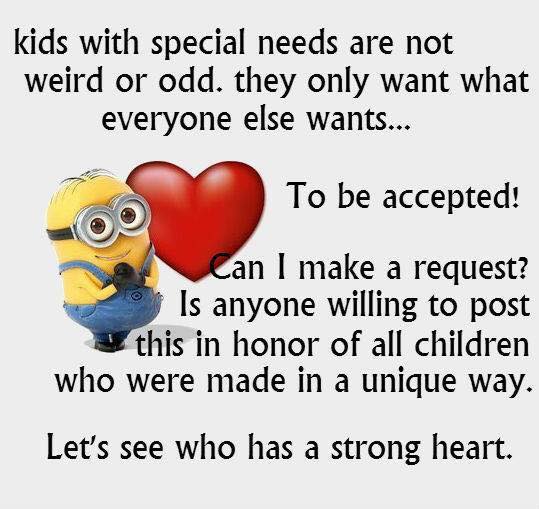
But the one that really gets me are the “children with special needs need to be treated like anyone else” memes.
Like this one:
No. No, no, no, no, no. I won’t re-post this on Facebook. (Yes, I know it’s going to show up in my feed when I publish this blog post, but at least it’ll have an explanation with it.)
Do I want people to be aware that kids with special needs need to be treated just like everyone else? Yes. Do I want to be guilted into posting this because it shows I have “a strong heart”? No. Do I sound ungrateful right now? Maybe.
I don’t feel that I need a strong heart in order to love my two kids with special needs, and I don’t think anyone else requires a particularly strong heart to care about them. They just need to be observant and kind. Treating any human being with kindness is a simple matter of compassion and at least an attempt to understand. No one has to prove themselves as far as I’m concerned, unless actually confronted with a situation in which they can provide a smile or at least refrain from saying or doing something nasty.
I mean seriously, how far does one of these Facebook memes go? If someone is confronted with an uncomfortable situation in a public place where an Autistic adult walks up to them and begins to talk about his or her imaginary friend, does the poster of the meme remember they posted it and take it to heart? No. The last thing on someone’s mind in this situation is Facebook.
Rather than posting a meme, learn something. Take the time to think about what you’d do. Read articles written by the parents of a special needs child and take their advice. Being guilted into posting on Facebook is useless unless you know what it means.



 lindaghill.com