NOTE: Pingbacks are not working this week. If you’d like to participate in the prompt, please manually enter the link to your post in the comments below. Thanks for your patience.
Anyone who would like to participate, feel free to use the “One-Liner Wednesday” title in your post, and if you do, you can ping back here to help your blog get more exposure. To execute a ping back, just copy the URL in the address bar on this post, and paste it somewhere in the body of your post. Your link will show up in the comments below. Please ensure that the One-Liner Wednesday you’re pinging back to is this week’s! Otherwise, no one will likely see it but me.
As with Stream of Consciousness Saturday (SoCS), if you see a ping back from someone else in my comment section, click and have a read. It’s bound to be short and sweet.
Unlike SoCS, this is not a prompt so there’s no need to stick to the same “theme.”
The rules that I’ve made for myself (but don’t always follow) for “One-Liner Wednesday” are:
1. Make it one sentence.
2. Try to make it either funny or inspirational.
3. Use our unique tag #1linerWeds.
4. Add our new, very cool badge to your post for extra exposure!
My “J”-word is a bit of a stretch, but it’s the only way I could find to talk about an important subject without taking up another letter. So here we have “jab,” by which I really mean “point” and “poke.” Both actions are important in American Sign Language, more the former than the latter, however. Confused yet? I’ll explain.
Growing up we’re all told it’s rude to point. Pointing though, is an essential part of ASL vocabulary. You, me, he, she, and it, are all indicated by pointing. It took me a while to get over the ingrained sense of right and wrong; of needing to point but not wanting to. Now I do it all the time – and I get a lot of strange looks, particularly when Alex and I are out, pointing all over the place.
Poking, on the other hand, is a less-desirable way for a Deaf person to get someone’s attention. Alex loves to poke me with a sharply pointed finger, especially when he wants something he can’t have. Normally, a tap on the shoulder is used. Coming into physical contact with other people, even strangers, is natural in the signing world. It’s necessary. The other day in a coffee shop, I was watching a lady who I know is Deaf, trying to get through the line-up for the counter; she was on her way out. Her shoulder-taps were met with a mixture of surprise and, in one case, almost hostility. All she could do was smile and try to look friendly. The people in line had no way to know she was Deaf, and probably wondered why she didn’t just say, “excuse me,” like any civilized person would.
Alex is still small enough that he can get away with a lot of things in public. He smiles at people and they smile back. He touches them and it’s innocent; he’s still only a little above four feet tall. I’m not sure he’ll grow much more in height, but he’s bound one day to grow facial hair. When that happens, he’ll go from cute to uncivilized in the eyes of society. It’s difficult, even for a mom, to explain away.
My A to Z theme concerns the joys and challenges of being the hearing mother of my Deaf son, Alex. To learn more about his beginnings in life, click here to go to my first A to Z entry.
I remember the first time someone called me using TTY plus Telephone Relay Service. The way it works is, the telephone company has a hearing interpreter with a TTY (teletype) device between the hearing person and the Deaf person. On the Deaf person’s end, they are either watching the interpreter sign on screen, or reading on the device. In between, the interpreter is listening and signing or typing, and on the hearing person’s end, he or she must speak and then say, “Go ahead,” when finished. It’s a complicated, and at first awkward, but effective method of communicating.
I also remember the first time I spoke to a Deaf person through an interpreter face-to-face. Again, awkward. First, I wasn’t sure where to look. When the Deaf person signed to me, I was able to watch and listen to the interpreter at the same time. But when I spoke, the Deaf person watched the interpreter. I wasn’t sure who I should be looking at. I’ve since gotten a bit more used to it. Second, I never know how fast to talk. I get caught up in watching the signs, and when I catch one I know, I realize how far behind the interpreter is, so I slow down. …or is he/she behind? There’s the backwards grammar to take into consideration too.
I didn’t have to deal with any of this until we moved to Ontario and Alex was enrolled in a Deaf school. Appalling anecdote, that was part of what actually led me to move:
It took about a year to finally have a speech and language pathologist visit Alex at school. It was a regular, English-speaking public school in the Province of Quebec. He had a wonderful EA working with him there, by the name of Lise. She was with him all the time. She spent her lunches tube feeding him and playing with him, and she actually came out of town to visit the Deaf school with me before we moved. Lise is hearing, however, and was at about the same level of American Sign Language I. We both knew it wasn’t enough for him to grow, so enter the speech therapist to advise on whether or not the school should fund an interpreter for him. The pathologist’s final assessment, after watching him in class a couple of times was that he couldn’t benefit from an interpreter, because at his current level of ASL, he wouldn’t understand the interpreter.
…
It’s like saying adults shouldn’t speak to hearing toddlers because they won’t understand anyway. How does one learn a language unless they are taught by someone who knows more, and is able to expand their vocabulary by example? And this from a woman whose job it was to teach language!
So we moved.
Since then, I’ve been muddling along, learning from what Alex brings home from school more than anything. We learned together, him by being exposed to ASL daily, and me from being exposed to my son. But we’re slowly getting back to needing an interpreter, and I don’t think it will be long before I have to have one at doctor’s appointments. He can now understand most things that are said in the adult world. At fifteen years of age he is still quite far behind mentally, but he’s a teenager. One of the most difficult things for me is knowing where his actual level of understanding lies. I have to rely on teachers for that. It’s like hosting a foreign student who I gave birth to, sometimes.
My A to Z theme concerns the joys and challenges of being the hearing mother of my Deaf son, Alex. To learn more about his beginnings in life, click here to go to my first A to Z entry.
I don’t know why I keep buying books. It’s a compulsion. If I spent just half my time reading all the novels I have on shelves, Kindle, and Kobo, I’m sure it would still take me a year to get through them. And don’t even get me started on my to-be-read list of books that I haven’t bought yet.
As it is lately, I seem to be spending half my time on the computer, whether the laptop or working on my novels. I haven’t done a lot of real writing lately, which is why I’m trying to post every day on my fiction blog. …where I don’t have even near half of the traffic I get here. I wonder why that is? I suppose if you click my gravatar it brings you here, rather than there. Have you clicked your gravatar lately? Where does it go? Actually, your gravatar is only half of it. When you click your picture it should take you to a site where you have all your information, and your blogs lined up in a neat clickable row. If you click your name (we’re talking about in the comments section of any given post where you’ve commented, now), it should take you to your main site. It’s frustrating when I want to find someone’s blog but their information isn’t available.
I’m half of a mind to complain to WordPress about the pingbacks not working, but complaining never seems to do anything. I wonder if their own Daily Post blog is suffering, since it relies on the same idea of pingbacks. Anyway, if it’s not fixed half-way between now and Wednesday, I’ll go through the process of bitching about it.
That’s at least half of what I can come up with at the moment. The other half would be forcing it. Happy weekend, all, and don’t forget to manually add your link to the prompt post this week!
Deaf people have to survive in a hearing world. This is a fact. If there are such things as Deaf stores, and Deaf hospitals, I don’t know of them. There are, of course, Deaf people working in public service positions–my bank has a Deaf teller–but it’s uncommon.
As the parent of a Deaf child who is growing up and will one day, hopefully, be independent, the fact that my son will out alone in a society that views him as different, is a concern for me. Alex is at a disadvantage, having not grown up exposed to his first language as most children are. Immersion into American Sign Language didn’t happen, and so by the time he reached the Deaf school that he now attends, he was years behind many of his peers. But at the same time he has an advantage. He’s already learned how to communicate, somewhat, with the hearing. He has an innate understanding that he needs to demonstrate what he wants without being able to verbalize. He has adapted.
On the flip side, I remember a story that my ASL teacher told us when I was in my third year of classes. He was the only Deaf member of his family. He told us of family gatherings and dinners when he was a child and through his teenage years when he would sit and eat, and no one would talk to him. They were all busy yammering away; he said he felt completely isolated. Consequently, he moved away–right out of the province–and had stayed away since. I can’t say he hated his family, but he seemed extremely bitter.
I fear this happening to Alex. I try my best to translate for him during dinners, but it’s difficult. First, keeping up with the conversation in ASL when my vocabulary isn’t up to par, and second, signing with a knife and fork in my hands. Despite this, he seems well-adjusted. I do what I can to make sure he’s included, at least in discussions that concern him. It’s more difficult when I’m talking with someone about something that doesn’t – with hearing kids, boring adult talk is naturally tuned out. Again, he’s at a disadvantage – if he was part of a Deaf family, he’d know to ignore it without having to be told it doesn’t concern him. On my end, I’m constantly saying to him, “It’s nothing.” I can only hope that he can tell by my body language and facial expression that I’m being sincere, and not just dismissing him as unimportant.
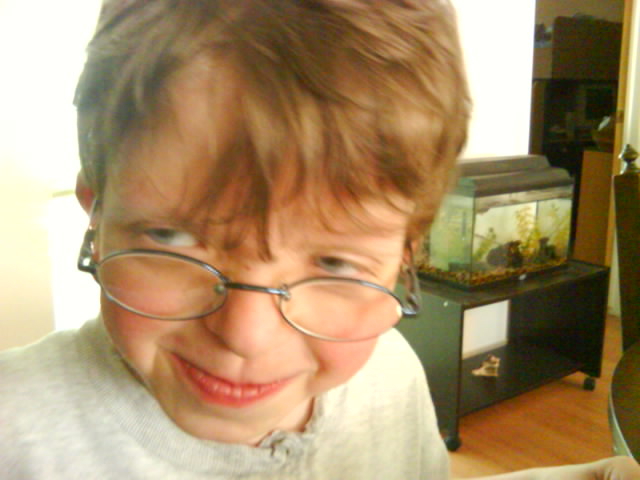
Alex, 2009. His usual charming self.
My A to Z theme concerns the joys and challenges of being the hearing mother of my Deaf son, Alex. To learn more about his beginnings in life, click here to go to my first A to Z entry.
You might think that American Sign Language is an extension of English, and therefore the grammar is the same. It’s not. This creates a bit of a sense of multi-tasking whilst trying to speak and sign at the same time, but with practice it can be done. I know my Sign grammar is not great, but there are a few things that are easy to remember, and a few that are necessary.
One thing I learned fairly quickly NOT to do, is say to my Deaf son, Alex, “Look at that!” when I want him to notice, say, a bird flying overhead. If I say, “Look, a bird!” it’s totally wrong. Why? Because if I sign “Look!” or even point at something, I’ve lost Alex’s attention on myself, so he has no idea what he’s looking for. If he could hear, he’d listen for further instruction. But he’s Deaf. So while he’s gazing out he window at the trees, I’m wildly signing the word “bird” for my own benefit. The proper way to do it in ASL is, “A bird, look!” Alex will then know what to look for. ASL grammar is important.
Another instance is the verb “to be.” It’s pretty much eliminated from ASL. Unlike Signed English, which, to quote Google, “…is a sign language dialect which matches each spoken word of English,” ASL, as you may have guessed, has a grammar unique to the needs of Deaf people. If I want to say “I am going,” I sign, “I go.” If I want to say, “I went,” I sign, “I go finished.” For a visual https://www.signingsavvy.com/sign/WENT/6576/1 I often speak to Alex out loud when I sign to him, and many times, since my brain is rarely up to multi-tasking, I’ll say exactly what I’m signing, which must sound quite funny to anyone listening.
Because tenses are pretty much non-existent in ASL it’s important to mention the “when” at the beginning of a sentence, when the action will take place in the future. For example, “Tomorrow, we go to the toy store.” This has become an ingrained part of Alex’s sentence structure. Which means if I say it backwards: “We’re going to the toy store tomorrow,” Alex gets his coat on first, and then waits to find out what we’re doing tomorrow.
It really takes grammar-nazi-ism to a whole new level.
My A to Z theme concerns the joys and challenges of being the hearing mother of my Deaf son, Alex. To learn more about his beginnings in life, click here to go to my first A to Z entry.
When learning any language, we start with the basics, introducing ourselves, explaining where we live, etc. Then we begin to learn the names of things so we can ask for them. All of this is fairly straightforward. But when we learn a new language, we’re normally doing it for ourselves, for travel or to communicate with a native speaker. We’re not usually learning it in order to teach a child his or her first language.
While pointing and naming is all well and good, children ask why things are the way they are. It’s practical. How do we know the difference between the consequences of stealing a cookie versus running out into the middle of a busy intersection? Hopefully not by experience. Obviously, the consequences of getting hit by a car was something I learned to communicate to Alex early on. But what about the more innocent stuff?
Why is the sky blue? How do wireless electronics work? Why is this Russian/Korean/Indian show on my laptop but it’s not on TV, like The Price is Right is? (He watches shows from all over the world; spoken language is of no consequence to him.) I have no way to answer many of his questions, short of becoming completely fluent in Sign Language. The closest place to receive such an education is in Toronto (Ontario, Canada), which is too far to commute to, to take classes I have neither the time nor the money for at the moment.
I might have advanced my education more after Alex was born, but the courses in Ottawa only went to a certain level. On top of that, we lived in the Province of Quebec – a province that has its own Sign Language (Langue des signes du Québec). Finding a professional to teach Alex American Sign Language in Quebec was next to impossible, and the only Deaf school for children in Ottawa teaches LSQ. So we packed up and moved to Ontario, to a city with a school whose primary language is ASL.
I do hope to learn more Sign someday. For now, I’m doing the best I can with help from his teachers.
My A to Z theme concerns the joys and challenges of being the hearing mother of my Deaf son, Alex. To learn more about his beginnings in life, click here to go to my first A to Z entry.
My A to Z theme concerns the joys and challenges of being the hearing mother of my Deaf son, Alex.
They say being deaf makes the eyesight better, but I had no idea what that meant until I took American Sign Language classes. Not hearing doesn’t improve the quality of a person’s eyesight – no one is going to from 20/200 (being able to only read the giant “E” at the top of an eye chart) to 20/20 because they are deafened. “Having better eyesight” simply means the brain works faster with visual stimulation. Take, for instance, the alphabet. Say it out loud as fast as you can possibly say it, and then consider a native signer can fingerspell it as fast as you can say it, and the average Deaf person can understand every letter as well as someone who hears can understand your speaking of it. Mindboggling, isn’t it? I used to come home from my three-hour classes once a week exhausted like I’ve never been exhausted before, and just because of the level of concentration required.
A to Z in ASL
What this means for me as a parent is that Alex doesn’t miss much. Even as a toddler, he was far more observant than the average kid. His attention to detail was such that, even before he knew what the letters of the alphabet were, he could match seventy-odd black VHS tapes by the labels together with their covers. It also means that he can easily pick up on facial cues.
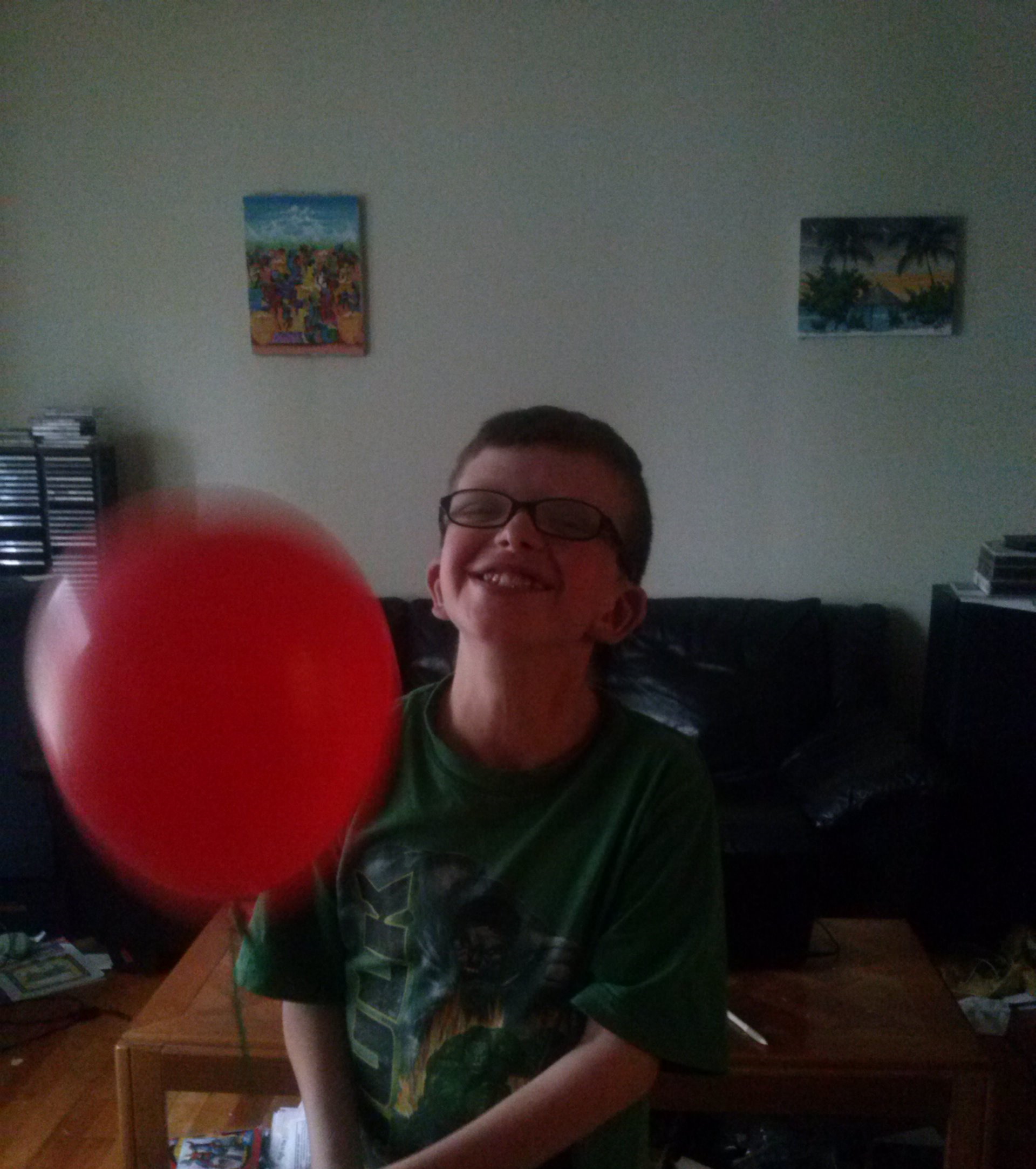
Alex watches the show Ellen every day. He loves the way she dances and often mimics it. Sexy hip-grinding stuff? He’s on it. He’s also the size of a six-year-old, even though he’s fifteen, so he looks very cute doing it. This makes it very difficult for me to tell him to stop dancing like that in public. No matter what I sign, (stop, that’s rude, etc.) there’s a part of me that finds it funny. It’s easy for him to ignore what I’m saying with my hands, when the slightest twitch of an eyebrow tells him that he’s amusing me.
Believe me, you never want your teenagers to be able to read your mind. Mine can.
Anyone who would like to participate, feel free to use the “One-Liner Wednesday” title in your post, and if you do, you can ping back here to help your blog get more exposure. To execute a ping back, just copy the URL in the address bar on this post, and paste it somewhere in the body of your post. Your link will show up in the comments below. Please ensure that the One-Liner Wednesday you’re pinging back to is this week’s! Otherwise, no one will likely see it but me.
As with Stream of Consciousness Saturday (SoCS), if you see a ping back from someone else in my comment section, click and have a read. It’s bound to be short and sweet.
Unlike SoCS, this is not a prompt so there’s no need to stick to the same “theme.”
The rules that I’ve made for myself (but don’t always follow) for “One-Liner Wednesday” are:
1. Make it one sentence.
2. Try to make it either funny or inspirational.
3. Use our unique tag #1linerWeds.
4. Add our new, very cool badge to your post for extra exposure!
My A to Z theme concerns the joys and challenges of being the hearing mother of my Deaf son, Alex.
By now, if you’ve been following my A to Z posts, you might have noticed that sometimes I capitalize the word, “deaf,” and sometimes I don’t. It’s not as random as it might at first seem.
Being “deaf” with a small “d” refers to a physical condition. People who go deaf as they age will probably always be “deaf” as opposed to “Deaf.” “Deaf” with a capital “D” refers to someone who is part of the Deaf community. Those born into families who are already part of the community are considered “Deaf” from birth. Think of it like being born English, or African, and you’ll get the picture. Alex was born (or became shortly after birth) deaf. It wasn’t until he learned American Sign Language as his first language that he could be considered Deaf.
As his mother, again I was faced with a huge decision in regards to his deafness. He had an MRI to assess the extent and cause of his hearing loss, and it was determined that he would qualify for a cochlear implant*, which would allow him to hear, somewhat. It wouldn’t have cost me anything – he was deaf enough. I hadn’t realized that there was a chance I would have to pay for it. But that wasn’t my main concern anyway.
By the time he had his MRI, I had started taking formal American Sign Language classes at the Canadian Hearing Society in Ottawa, and he’d already started learning ASL. The Deaf community is tight-knit, with a culture that is unique to them. They tend to protect their culture with a fierceness that equals that of any other culture worldwide, and with reason. It is often misunderstood, as are the Deaf. I’ll get into that discussion on another day, however. My own focus was, of course, on my son, and I needed to decide whether or not he would be Deaf, or remain deaf.
It may seem like an obvious decision at first. I could have had my little hard-of-hearing child to myself, with his cochlear implant, and his tiny fingers that we still weren’t sure would ever be able to sign properly because of his low muscle tone. This last was related to both his Noonan Syndrome and the fact that he had spent eight months in a hospital bed instead of learning to play. Excellent reasoning to have a hearing child.
However, he’d been tube-fed from birth (and still is). On the surface this was completely unrelated, until an occupational therapist explained to me that, because he never learned to suck as an infant, the muscles in his mouth hadn’t developed properly. He would never learn to speak. His dad and I were still undecided when we went to see the surgeon who would perform the operation for the cochlear implant. We felt that it was important to know all the details involved in the procedure, so we could make an informed decision. The moment I heard the words, “five-hour operation,” and “drill a hole in his skull,” I threw up my hands and accepted that I would have a Deaf son. He’d been through enough.
To learn more about Alex’s beginnings in life, click here to go to my letter “A” post.
To learn more about cochlear implants, click here.




 lindaghill.com