It’s the question I am most asked about my thirteen year old son. At 60 pounds and 4’3″, with the amount of enthusiasm he has for everything, he can easily pass for an eight year old.
Born Deaf, his lungs are compressed by his large, deformed heart. He’s barrel-chested and is covered in scars, least of which is the tube in his stomach from whence he receives 99% of his nutrition. He is hooked up to a feeding machine about five hours a day. I’m sure he experiences pain – more than likely he’s been through more than most of us in his short life.
But I marvel at his little body. That he keeps going without complaint – he’s never known any different. I’m sure he’s realized by now that he’s not the same as most kids. One of his major goals in life is to eat in the cafeteria with the other kids at school, instead of being sent to the infirmary for lunch every day.
It amazes me what the human body can endure and still keep going. We think of ourselves as fragile. We grieve when something stops working. Our eyesight fades, our hearing goes, our muscles tire more easily – but imagine if you had always been this way.
My son is a constant inspiration to me. Everywhere he goes he makes people smile with his joy in life.
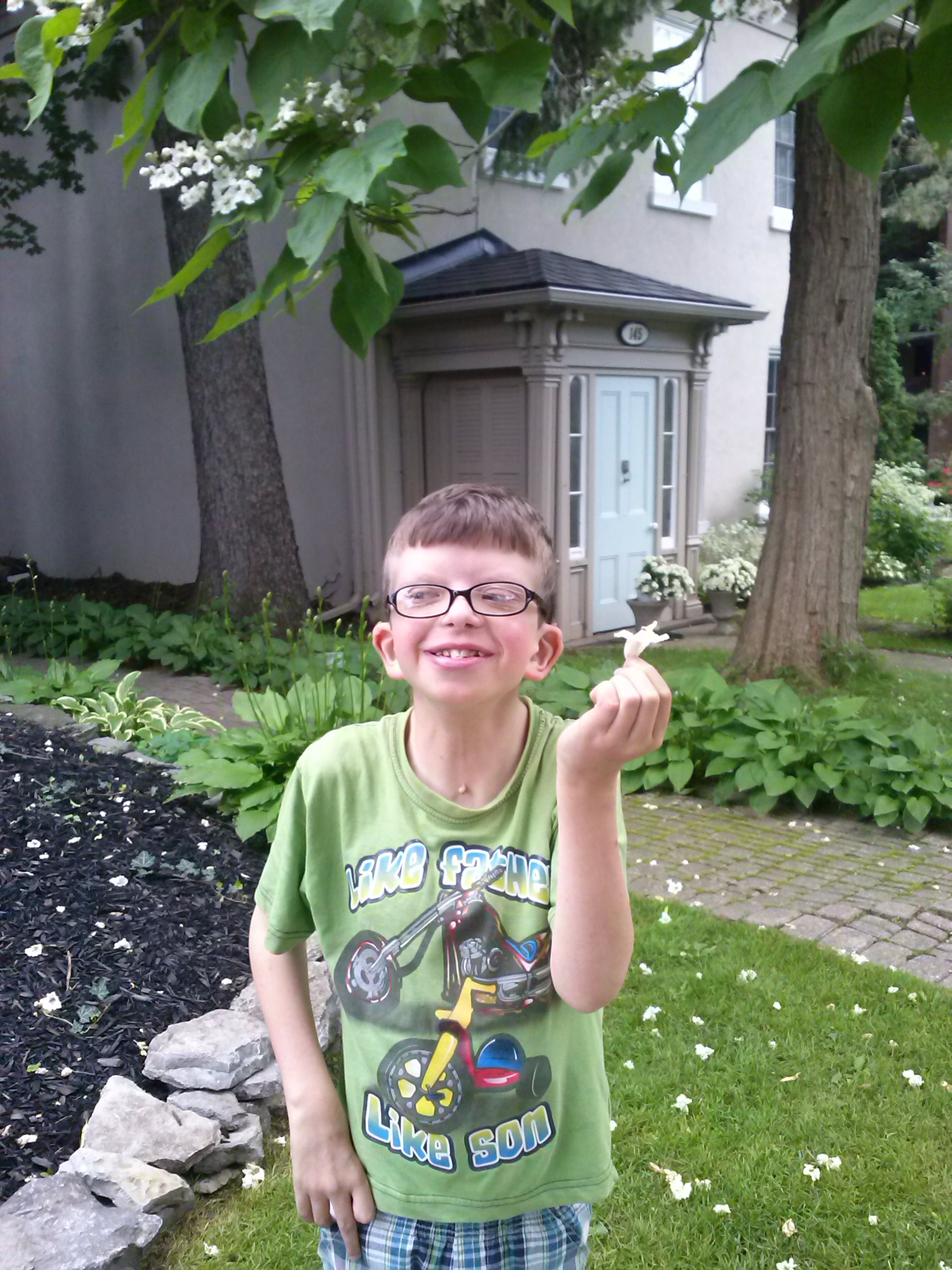
I’m not sure what kind of tree this is, but I thought the blossoms were pretty.
Of course my helper for today’s paper route wanted his picture taken with one. Not sure what was distracting him, but the good news is, nothing ran me over.
As I waited in the Emergency Room with my elderly mother today, I listened to two strangers discussing the horrors of what they had heard routinely goes on in ERs across the country. And horrors they were.
One spoke of elderly patients dying in chairs and on gurneys whilst being ignored by overworked staff members; the other gave an account of a friend of a friend whose nine year old daughter died after not being properly treated. As the story went, two doctors of opposing opinions argued over the proper care of the child. One believed the girl had pneumonia and wanted her on antibiotics but the other decided it was a mere cold. The latter of the two was also on the latter of two shifts and won out. The nine year old lasted two days before flesh-eating disease got her. The parents are still waiting for the lawsuit to be tied up a year later.
In all of these cases, the tragedy which resulted might have been avoided with the presence of a competent patient advocate. After a cursory search in my own area of the world, which is Ontario, Canada, I discovered that finding an outside advocate isn’t easy. (I did only a quick search because had I been looking for an advocate in the case of an emergency, it’s logical that that’s all I’d have time for.) I found that it’s possible to get one to accompany a patient to appointments, etc., but the advocate must be interviewed in advance and paid for – highly inadequate in the case of having to go to the hospital in an emergency, and inaccessible for someone with no money. In any case, most of us rely on family and friends to advocate for us, as was the case with the little girl.
I have no way of knowing what the parents’ knowledge of medicine was, nor what their levels of intelligence are, but I do know, as a parent, that most mothers know what their children are like when they’re healthy and how they act when they’re sick. Was the mother in tune with her daughter but unable to express her concerns to the doctor? Did the doctor simply choose not to listen? Again, I don’t know. What I do know is that it’s important for us to have at least a little understanding of what our loved ones are facing before we take the trip to the hospital in the first place. If that means going on the internet to search for the symptoms, so be it. At least we’ll know what questions to ask when faced with a busy doctor, and what to insist on as far as tests go.
I can’t help but think that these horrific events could have been prevented with the right amount of basic knowledge, advocacy, and attention to detail.
It’s scary to think that doctors don’t know what they’re doing. It’s frightening to know that our hospitals lack the funds to provide quality of care. But what is just as alarming is the fact that there’s no one to stick up for us, the patients, when we can’t or won’t stick up for ourselves.
When I thought of the tongue prompt yesterday I had no idea what I wanted to write. It just seemed like something people could have fun with. That hasn’t changed – I still don’t have any idea what I want to write.
There are so many things we can do with our tongues:
The first of course is taste – it’s one of the first things we do when we enter the world. Our tastes grow as we get older. Sure, there are things we can’t stand to eat, even as kids. Much to the annoyance of parents everywhere, often these foods end up in places they shouldn’t. I still remember picking sticky pieces of spaghetti off the walls when my kids were toddlers.
Shortly after taste comes our mother tongue. Or, in some cases, not. My son Alex will never know his mother tongue because he’s Deaf. Is Sign Language even a tongue? Maybe not, but Alex is certainly vocal enough. That’s something that comes with having hearing parents though. In completely Deaf families, they don’t use their voices.
Shortly after we learn to speak we learn to do other things with our tongues. Stick them out at people, for instance. (Thanks Lee-Anne for reminding me of that one.) Some of us do tricks like twist them or curl them – which as I understand is something that is inherited. If your parents can’t do it, neither can you. I can lick my nose though…
As we grow up we learn to use them for kissing. I remember my first kiss – however I’d rather not. There was a lot of drool involved and I don’t think most of it was mine. Ick.
From that first kiss we graduate… My mother used to call it “sucking face” though I’m not sure that that was an expression she grew up with. Then there were the hickeys that we tried and usually failed to hide from our parents. As I write this, I realize how much hell parents go through!
And of course there’s the next step.. but I won’t get into that here. Best left for the bedroom, eh?
That would be everything I can come up with, and I still don’t know that I’ve said anything of importance or worth reading.
Except the next time I go to the doctor and I see the tongue depressors, I’ll probably think of this post.
On Traces Of The Soul, Oliana wrote: This week the topic will be about negativity and how you react to pessimism. Perhaps you are thinking how you recently managed to get away from the throngs of a negative person in your life, i.e. relationship, friendship, family, work…OR, how you succeeded in turning your own self-destructive side…that inner critic to someone more positive and accepting.
Write a poem, story (real or fiction) about this topic…negative thinking and how it can impact on your life.
The prompt got me thinking about negative people and how I grew up, and most importantly what I’ve learned in the intervening years. First, a little background:
I was a quiet child with no siblings and few friends. My world consisted of my parents and the couple that were their best friends. When I wasn’t quiet – when I got into trouble – my parents spanked me. It was the ‘thing to do’ back then. When I yelled, they yelled back. The point was, they always reacted. Unless I was being good. Then they left me alone.
Fast forward to when I had children of my own. I believed in my parent’s method of raising a child, though not with the hitting part. I admit, I had my moments, but most of the time I refrained from smacking if not from the yelling. There was plenty of yelling – I, like my parents, reacted in kind to my children’s tantrums.
Then, about three years ago I learned something that would change not only my life, but those of my children and the people around me: Applied Behavioural Analysis, or ABA. ABA is widely used to help with negative behaviours in Autistic individuals. But it didn’t take me long to figure out that it can be applied to anyone – even myself.
One of the most important lessons I learned was that everything we do and say when communicating for attention can be considered a ‘behaviour.’ For instance, we smile and say hello to a stranger which is a positive behaviour. The attention we receive back is our reward – it is a reward because we elicited our behaviour for the purpose of getting attention. In the case of my children, I found that when I rewarded their good behaviour with attention and ignored the bad, they quickly came to the realization that if they wanted my attention (or for me to react to them in any way at all) they had to be calm. Yelling and screaming to get a reaction out of me became a thing of the past – and it changed my reaction also. No longer was I screaming at them, because they began to come to me with a reasonable tone of voice in the first place.
As I said, this doesn’t only apply to childish behaviour (though many adults display it on a regular basis). Take internet trolls for instance. They display negative behaviour for what? A reward. Their reward is whatever attention we give them. The whiners of the world? I’ll try once to put a positive light on a comment such as, ‘when will this rain end?’ by saying something like, ‘the grass needs it.’ But when they keep on complaining, I change the subject to something more positive, or walk away. Many of us do this without really thinking about it. But it’s different when you’re talking to someone in a casual setting rather than someone you’re with day in and day out. Politeness goes by the wayside after a while, and you either react to it or give in to it and become, basically, the same negative person you’re with.
I’ve always been a ‘cup half full’ sort of person. There have been times in my life when I’ve lost sight of that, I’ll admit. But learning not to react at all to unnecessary negative behaviour (which is not to say that I don’t empathize with people who are genuinely struggling) has made me a more patient, calm and positive person.
When my son Christopher came home with it from school, I asked him if it was Mr. Potato Head. He looked at me as if I was crazy and said, “It’s a clown!”
I’ve had this … head sitting on my kitchen counter for about three months now. It goes from making me sad, to creeping me out and back again, sometimes within the space of minutes. This disembodied head is my companion when I cook, when I wash dishes, and whenever I go looking for a snack. Unfortunately it’s never distracted me enough from a midnight snack however, to prevent me from getting one.
So where am I going with this post?
It makes me think about the lives our kids lead when they’re not at home. They have this whole other world when they go to school where they probably never think of us, except in terms perhaps of whether or not we’re going to make their favourite dinner that night, or did we go pick up the thing they wanted at the store. The way they slowly separate themselves from us as the years go on is both scary and comforting. To know that they may just have enough interests that have nothing to do with us, enough to one day have lives of their own secures in my mind at least that they’ll be okay when we’re gone.
Even if their lives away from us consist of creepy disembodied heads. As long as they’re ceramic, I’m happy.
That awkward moment when you’re concentrating really hard on making the bed until you realize that all three of you are sticking your tongues out but you’re the only one without ice cream.
As a child I was led to believe in Santa Claus, the Easter Bunny and the Tooth Fairy. I don’t remember when I discovered the truth about the latter two, but I do recall feeling betrayed by my parents when I reached into my stocking one Christmas morning and pulled out a gift with a price tag on it. At first I refused to believe it – they couldn’t possibly tell me such a blatant lie, these two adults who were constantly stressing to me the importance of telling the truth. But alas, we all know how it turned out. I’ve been wary of humans ever since.
Even worse than this, in my opinion, is telling kids that they can grow up to be whatever they want to be. I’m sorry, but if you stop growing when you hit four feet, you will not be a Harlem Globetrotter, nor will you be a famous opera diva if you can’t carry a note in a bucket. You will never be President of the United States if you were born in another country, no matter how much you want it.
I don’t care who you are – everyone has limitations. As adults, we learn what these are, and yet I still hear adults lying to generation after generation, promising children who can’t possibly know any better that they can do ANYTHING and be ANYTHING they want to be when they grow up. It’s total, utter bullshit.
In my own case, this on top of being told that everyone is good at something, left me feeling woefully inadequate. I wasn’t about to believe people who would tell me that I was a brilliant singer – these were the same people who told me there was such a thing as Santa. Hindsight shows me that in most cases, it’s just as well. Just look how many end up on TV talent shows only to be laughed at? So if I couldn’t be good at doing something I loved, what could it be? I tried guitar, figure skating, horseback riding … and ended up a bookkeeper. I couldn’t even type that fast. It’s only in the last fifteen years that I’ve discovered my passion for writing.
But I digress. The incident that brought this whole topic up was a conversation I had with Chris, my Autistic eighteen year old, in the car on Sunday. He told me he wants to be a radio announcer. I know for a fact that he’s been told he can do anything he wants. Radio announcer isn’t one of them, nor will it ever be. He can barely get more than two coherent sentences out of his mouth on the best of days. So I get to be the bad guy. I have to tell him he can’t do it. I tried to explain to him that he needs to get hired in order to talk on the radio, but he can’t understand why anyone won’t just hire him.
I can say with all honesty that I was reluctant to let my kids to believe in Santa. It came down to the question of whether or not to allow them that wonder I remember feeling when I did believe. But I can also say I never really tried to convince them he existed.
I’ve always maintained a realistic outlook for their lives. I’ve been truthful in telling my eldest that he can do almost anything. There are many things Chris will never do and I’ve always tried to steer him towards what is feasible. Alex as well. He will certainly never sing opera – and none of them will ever be President.
I’m sure there are people out there who have become exactly what they wanted to be – we all knew someone who was incredibly gifted and knew what they were cut out for at an early age – but few of them actually turned out to be the superhero they always dreamed they’d be (yes, that was one of my dreams too).
If you were like me and Chris, and your aspirations were outside the realm of what is achievable, then perhaps you’ll agree with me. Or maybe you were more down-to-earth in your expectations. In either case, telling a child they can do or be absolutely anything is something I’ll never do and something I wish others would put a little more thought into. You never know whose dreams you’ll eventually be dashing.
At the ripe old age of 50, I’m seriously considering starting a career. At the moment I have no income whatsoever, apart from the $15 I bring in every week (I know, put your jaw back in place) from my paper route. The government supports my kids because of their disabilities and we all live off that. If I’m ever unable to physically care for them anymore, or if they by some miracle are able to look after themselves, I’ll have nothing. Even now, I’m living beyond my means.
So I’ve been looking into University level courses to get an Editing Certificate. I’ve enjoyed the proofreading/beta reading I’ve done so far, and it’s something I could do from home, on a freelance basis. There are no Universities in the area that offer the course, however, so I’d have to do it online. Even if there was a course available close by, I’d have a hard time getting there with the limited time I have free due to looking after the kids. Add to that the fact that I can’t always be reliable given a certain day and time, and the concept of going to University is pretty much a flushable one.
Originally I was looking into the idea of taking a copy editing course, or even some more creative writing courses. I recognize though that it’s not recommended that one does one’s own final edit. And so no matter how good I am at writing, or how much I think my writing is perfect, I know it won’t be. If, on the other hand, I learn to edit other people’s work and get some money coming in from that, I’ll be able to afford to pay an editor to edit mine. It’s kind of like the old adage, “Give a man a fish and he’ll eat for one night, but teach a man to fish and he’ll eat his entire life” … except this fisherwoman will still be asking other people to fish for her. And THEN, maybe I’ll be able to do something about the little red line that goes under “fisherwoman” but not “fisherman.” First the Certificate, next, the world! Or at least the world of spell check.
Anyway, that’s what’s been going through my little brain of late. I’ve always wanted to go to University. About time I did, if I’m going to. Never too late to start, right? I don’t want to be sitting around in two years thinking to myself, “If only I’d started two years ago, I’d be finished now,” after all.
Is there anything you’ve wanted to start and thought it was too late? Has this made you want to get off your butt and do it?



 lindaghill.com