My A to Z theme concerns the joys and challenges of being the hearing mother of my Deaf son, Alex.
They say being deaf makes the eyesight better, but I had no idea what that meant until I took American Sign Language classes. Not hearing doesn’t improve the quality of a person’s eyesight – no one is going to from 20/200 (being able to only read the giant “E” at the top of an eye chart) to 20/20 because they are deafened. “Having better eyesight” simply means the brain works faster with visual stimulation. Take, for instance, the alphabet. Say it out loud as fast as you can possibly say it, and then consider a native signer can fingerspell it as fast as you can say it, and the average Deaf person can understand every letter as well as someone who hears can understand your speaking of it. Mindboggling, isn’t it? I used to come home from my three-hour classes once a week exhausted like I’ve never been exhausted before, and just because of the level of concentration required.
A to Z in ASL
What this means for me as a parent is that Alex doesn’t miss much. Even as a toddler, he was far more observant than the average kid. His attention to detail was such that, even before he knew what the letters of the alphabet were, he could match seventy-odd black VHS tapes by the labels together with their covers. It also means that he can easily pick up on facial cues.
Alex watches the show Ellen every day. He loves the way she dances and often mimics it. Sexy hip-grinding stuff? He’s on it. He’s also the size of a six-year-old, even though he’s fifteen, so he looks very cute doing it. This makes it very difficult for me to tell him to stop dancing like that in public. No matter what I sign, (stop, that’s rude, etc.) there’s a part of me that finds it funny. It’s easy for him to ignore what I’m saying with my hands, when the slightest twitch of an eyebrow tells him that he’s amusing me.
Believe me, you never want your teenagers to be able to read your mind. Mine can.
Anyone who would like to participate, feel free to use the “One-Liner Wednesday” title in your post, and if you do, you can ping back here to help your blog get more exposure. To execute a ping back, just copy the URL in the address bar on this post, and paste it somewhere in the body of your post. Your link will show up in the comments below. Please ensure that the One-Liner Wednesday you’re pinging back to is this week’s! Otherwise, no one will likely see it but me.
As with Stream of Consciousness Saturday (SoCS), if you see a ping back from someone else in my comment section, click and have a read. It’s bound to be short and sweet.
Unlike SoCS, this is not a prompt so there’s no need to stick to the same “theme.”
The rules that I’ve made for myself (but don’t always follow) for “One-Liner Wednesday” are:
1. Make it one sentence.
2. Try to make it either funny or inspirational.
3. Use our unique tag #1linerWeds.
4. Add our new, very cool badge to your post for extra exposure!
My A to Z theme concerns the joys and challenges of being the hearing mother of my Deaf son, Alex.
By now, if you’ve been following my A to Z posts, you might have noticed that sometimes I capitalize the word, “deaf,” and sometimes I don’t. It’s not as random as it might at first seem.
Being “deaf” with a small “d” refers to a physical condition. People who go deaf as they age will probably always be “deaf” as opposed to “Deaf.” “Deaf” with a capital “D” refers to someone who is part of the Deaf community. Those born into families who are already part of the community are considered “Deaf” from birth. Think of it like being born English, or African, and you’ll get the picture. Alex was born (or became shortly after birth) deaf. It wasn’t until he learned American Sign Language as his first language that he could be considered Deaf.
As his mother, again I was faced with a huge decision in regards to his deafness. He had an MRI to assess the extent and cause of his hearing loss, and it was determined that he would qualify for a cochlear implant*, which would allow him to hear, somewhat. It wouldn’t have cost me anything – he was deaf enough. I hadn’t realized that there was a chance I would have to pay for it. But that wasn’t my main concern anyway.
By the time he had his MRI, I had started taking formal American Sign Language classes at the Canadian Hearing Society in Ottawa, and he’d already started learning ASL. The Deaf community is tight-knit, with a culture that is unique to them. They tend to protect their culture with a fierceness that equals that of any other culture worldwide, and with reason. It is often misunderstood, as are the Deaf. I’ll get into that discussion on another day, however. My own focus was, of course, on my son, and I needed to decide whether or not he would be Deaf, or remain deaf.
It may seem like an obvious decision at first. I could have had my little hard-of-hearing child to myself, with his cochlear implant, and his tiny fingers that we still weren’t sure would ever be able to sign properly because of his low muscle tone. This last was related to both his Noonan Syndrome and the fact that he had spent eight months in a hospital bed instead of learning to play. Excellent reasoning to have a hearing child.
However, he’d been tube-fed from birth (and still is). On the surface this was completely unrelated, until an occupational therapist explained to me that, because he never learned to suck as an infant, the muscles in his mouth hadn’t developed properly. He would never learn to speak. His dad and I were still undecided when we went to see the surgeon who would perform the operation for the cochlear implant. We felt that it was important to know all the details involved in the procedure, so we could make an informed decision. The moment I heard the words, “five-hour operation,” and “drill a hole in his skull,” I threw up my hands and accepted that I would have a Deaf son. He’d been through enough.
To learn more about Alex’s beginnings in life, click here to go to my letter “A” post.
To learn more about cochlear implants, click here.
My A to Z theme concerns the joys and challenges of being the hearing mother of my Deaf son, Alex.
When I discovered Alex was Deaf, I knew I would have to learn Sign Language. However, there was no point starting a formal education too early. I knew from experience that if you don’t use a language, you lose it pretty quickly. So in lieu of classes, I devised a few logical signs of my own. I think the first I ever taught him, before he came home from the hospital at the age of eight months, was to let him know when I was leaving and coming right back. I simply held my index finger up as I walked out the door. When I was leaving for the evening, I waved goodbye so he would know the difference. It didn’t take long before he needed to know why people were exiting his room; he began to cry whenever a nurse left, even for a moment. “Just a second” was the first of many I would have to teach the nursing staff over the years. I found the signs for “mom” and “dad,” and a few others so I could add to both my vocabulary and that of the people caring for him in the hospital when I couldn’t be there myself.
Even now, fifteen years later, it’s necessary to teach the nursing staff how to sign whenever he stays in the hospital. And not just one nurse, because signing is usually the last thing they have time to relate to each other when they change shifts. They normally have 15 minutes to go through the medical history and changes of all the patients on the floor. If Alex is admitted for a few days, there’s a fair bit of staff rotation. When a hospital is close to a border, such as the Ontario/Quebec border in Canada, the staff are expected to be bilingual, yet there is no provision for teaching hospital staff Sign Language. At the very least, it should be mandatory to have a reference book on every floor. I had to buy one of my own and lend it, always hoping it would come back home after Alex’s stay.
For a child without diverse medical needs, this would only be a problem occasionally. For us, it’s an ongoing concern. I honestly don’t understand why it’s not mandatory to teach Sign in schools. If you follow my A to Z, you may agree with me by the time the end of April gets here that they should.
My A to Z theme concerns the joys and challenges of being the hearing mother of my Deaf son, Alex.
Though Sign Languages are as different as spoken languages worldwide, one thing is consistent; they all rely heavily on body language and facial expression. I’ll never forget the first time I was shown the sign for “not yet.” I actually laughed at my teacher, thinking he was joking. There was a mortifying moment. “Not yet” is exactly the same hand-sign as “late,” only with the tongue stuck out. (For a visual: http://www.lifeprint.com/asl101/pages-signs/n/not-yet.htm ) Anyway, by the time my son Alex started to learn American Sign Language I pretty much had my own face and body under control. Unless I’m angry, which is another story altogether. But when we go out in public, the results of people doing things without realizing it can range from amusing back to mortifying. For me. Alex has a blast.
For instance, almost any time I take him out, someone speaks to him. He’s a very engaging little boy. He smiles at people all the time. Invariably they ask him questions, and when they do, they smile back and usually nod their heads because they’re asking a positive question that they want him to agree to:
“Are you looking forward to going back to school?”
“Do you like Spiderman?” (Because he’s always either holding or wearing something to do with Spiderman.)
Alex sees them nod and smile and he nods back. He doesn’t need to hear the question. Which always puts me in the awkward position of having to decide whether or not to tell them he’s Deaf. Unless they ask him another question to which he would have to answer, for instance, “How old are you?” I don’t tell them. Why not, you ask?
People are embarrassed when they get caught talking to a Deaf person. It’s like they feel like they’ve suddenly made a fool of themselves simply by being friendly. When there comes a point at which I have to explain that the reason he’s not talking to them is he’s deaf, they either:
a) say, “Oh,” and walk away, pretending they didn’t speak to us in the first place;
b) say, “But he can lip-read, right?” because obviously he knew what they asked him. He answered the way they wanted him to! (I then say, “Yes, a little,” to ease their minds);
or c) whisper to me, “I’m sorry.” Depending on how I’m feeling on that particular day, I’ll either, say, “That’s okay, he’s just happy to interact,” or, “That’s okay,” and think to myself, Don’t feel guilty about it. It’s not your fault.
I sometimes wonder if, on some level, people know he has a good idea of what they’re thinking. Much of our body language is unconscious. We know we’re doing it, but we don’t always know when, or whether or not we’re controlling it well. And if that doesn’t make you feel self-conscious around a Deaf person, I don’t know what will.
Alex’s ability to read expressions gets embarrassing when he laughs at people. And he does, loudly and with great delight. Take, for instance, a scenario in which you’re out for dinner with someone you’re trying to impress, and you put something in your mouth that you discover you don’t like. You’re turning green at the gills but you’re trying to downplay it, so you grin and bear it while you continue to chew and swallow the offending piece of food. Meanwhile, at the next table, there’s a kid absolutely killing himself with laughter at the subtle expression you’re trying to cover up, while his mother, red in the face, attempts not to giggle at her offspring’s reaction.
All I can really do is try to distract him. I can’t say to the person, “He’s Deaf, and you look like you just put a live bug in your mouth.” It’s amazing how quickly people cease to be charmed by him in these situations. And they happen all the time. Of course I try to explain to Alex that it’s rude to laugh at people, but first, my vocabulary isn’t fantastic in Sign, so when he asks why, I’m at a loss. And second, how can I explain to him that he needs to suppress this wonderful ability to read subtleties that goes flying over the heads of most of the population? So I take it case-by-case and do my best to make everyone happy.
What do you want to be when you grow up? I used to hate that question. I never had a real answer because I had no idea. It, to me, was an impractical question. I’m ten! How would I know? Hold on, while I weigh my options… I used to be envious of the kids who could just spurt out a profession like it was what they were born for. How about, I want to be a caring, compassionate human being. It’s something else to know how you want to occupy yourself when you reach a certain age, isn’t it?
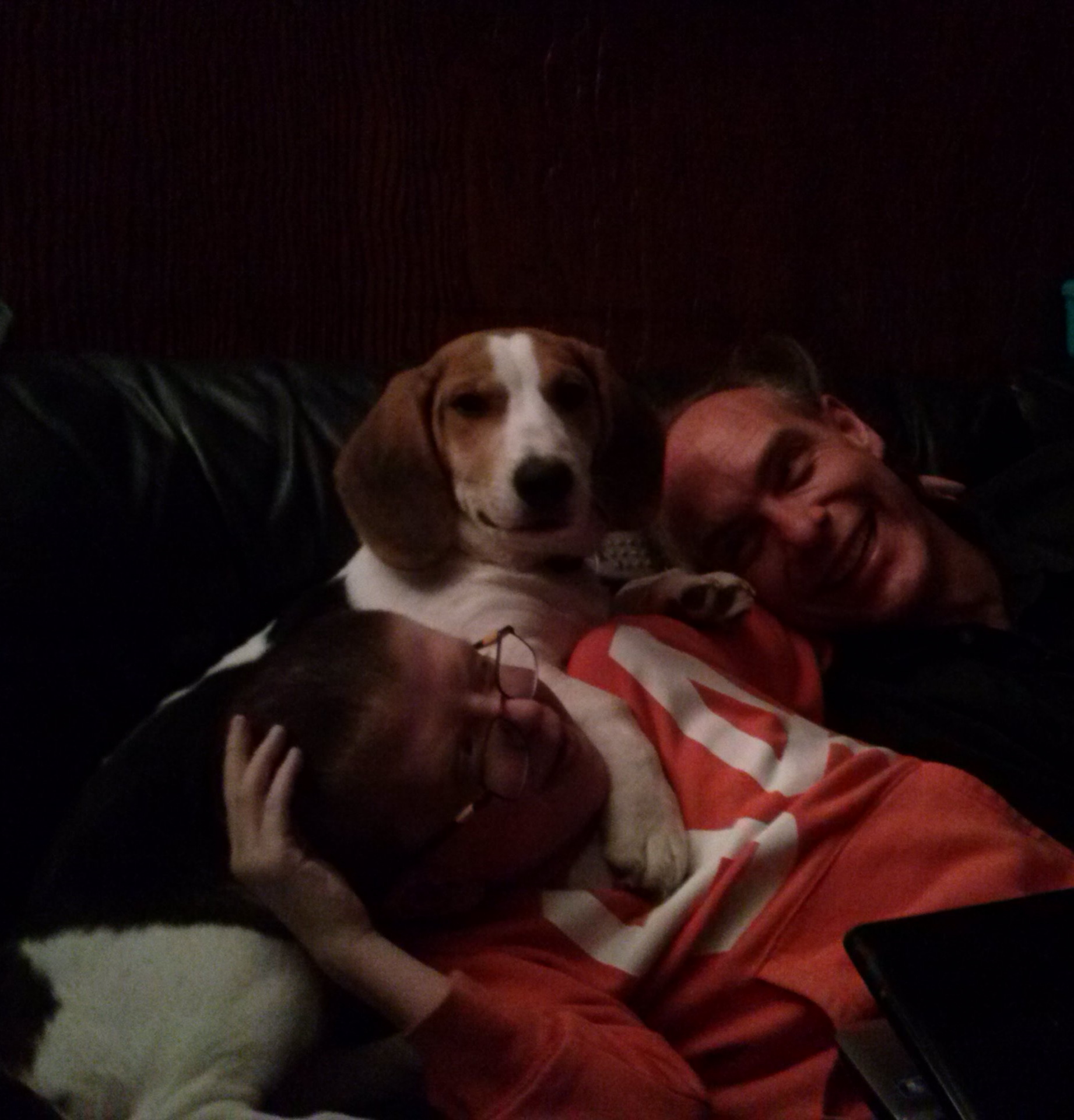
Right now I’m occupying myself with my laptop, awkwardly typing with the puppy’s head on my lap, and my kid is making weird gurgling noises at his own computer while he feeds from his pump. The tv is on but there’s no sound – nobody is watching it. Not even the dog. Is it true that dogs can’t see tvs? Is that a myth? Or was it just true of the old curved screens? Because Winston seems to be able to see my flat screen.
I had to get up to feed the dog. He made me put the computer down. I’m almost out of milk. I panic when that happens, because it means I’ll either have to drink my morning coffee black or not at all. And that last option is not an option. As my best friend observed, I don’t exist before coffee. I am not.
To be, or not to be? Ask me after coffee. I think my brain just exploded.
I knew Alex was going to have health issues when I had my first ultrasound, 10 weeks into gestation. He had, I was told, fluid around his heart and at the back of his neck. Down Syndrome was ruled out a few weeks later via amniocentesis. It wasn’t until he was born and transferred to the nearby Children’s Hospital of Eastern Ontario that he was diagnosed with the second most prevalent syndrome: Noonan Syndrome. To the geneticist it was obvious at first glance. Barrel-chested; low-set ears; thickness in the neck; and widely spaced, bright blue eyes. It was all there, on top of the multiple heart issues.
His prognosis was bad. Without surgery, his cardiologist told us his heart could no longer pump oxygen through his bloodstream. He would die within a year. The surgery itself came with a 50/50 chance of survival. It was a tough decision, yet an obvious choice. Just short of two months of age, he went to the operating room. About half-way through the procedure, the surgeon came in to let us know that Alex’s heart had stopped and he had lost all vital signs. They got him back after a few minutes by providing open-heart massage, but the surgeon said he would not resuscitate him again. It was time to close the suture and hope for the best. A couple of hours later we were told our little boy had survived.
The reason I go through this history when I’m here to talk about his deafness is, first, to explain why I reacted the way I did when I found out he couldn’t hear, and second, why he can’t hear. He was about four months old when I began to realize he wasn’t responding to noises. Since he was still in the hospital (he didn’t come home until he was eight months old), I had him tested right away. When the test proved he was profoundly deaf, I felt sad that he couldn’t hear me sing to him, and that he would never be quite like the rest of us, but hey – he was alive. Years later, I’m still realizing the impact of his difference in abilities, as you’ll see as the month goes on. Noonan Syndrome doesn’t include deafness as one of its genetic anomalies. The doctors told me it was likely the lapse in vital signs during the surgery which injured his brain. I had to wait to find out if he would have any other symptoms – as it turns out, I’ll probably never know.
It’s been a roller coaster of ups and downs, with oh so many laughs and challenges and opportunities to learn along the way. I hope you’ll enjoy reading about the ride.
Just before Alex finally came home (if I remember correctly, the weekend of the CHEO telethon in 2001 was his last weekend at the hospital) they filmed some of the inpatients to show at the end of the news. The baby at the end (2:24) is Alex.
I have to buy Easter eggs for next weekend to hide, for my youngest son to find. It’s going to be interesting this year with the puppy, making sure the right being finds the eggs. Apparently chocolate isn’t good for dogs anymore. I used to give it to my mother’s poodles all the time – no one told me not to. It didn’t seem to cause them any problems.
I must be a terrible mother. I hate deadlines to start with, but holiday deadlines are the worst. Easter, Christmas, birthdays… even getting ready for the day after Labour Day when the kids go back to school is a huge chore for me. I think it’s because I put so much pressure on myself to get it done. It’s more the stress of knowing I have to do it than actually having to do it. Shopping, that is. I really can’t stand shopping. But not as much as I hate deadlines.
I got egged once. You know how sometimes kids go around and egg cars at Hallowe’en? Well one Hallowe’en night when I was a teenager – it might have been either the last or the second-last year I went out trick or treating – I sat down on the curb to have a rest and a car came by and someone threw an egg out the window and hit me square in the middle of the forehead. Luckily I was close to home – I went and got changed and went back out again.
I have no idea where I was going with that story. But there it is.
This post doesn’t feel very much like Stream of Consciousness. I think I’m too stressed over the eggs. I wish there was a way to get out of my mind once in a while, you know?
I complain, when my youngest son, Alex, is here that I’m not able to sit down for five minutes without having to get up for something he needs or wants, but since he left for his dad’s on Friday I’m finding myself sitting for too long, so, at odds with myself, and unable come up with a One-Liner Wednesday for this week I began pacing the floor between the kitchen, and the living room and, with the puppy looking on suspiciously, came up with this long-assed run-on sentence that’s really going nowhere.
Anyone who would like to participate, feel free to use the “One-Liner Wednesday” title in your post, and if you do, you can ping back here to help your blog get more exposure. To execute a ping back, just copy the URL in the address bar on this post, and paste it somewhere in the body of your post. Your link will show up in the comments below. Please ensure that the One-Liner Wednesday you’re pinging back to is this week’s! Otherwise, no one will likely see it but me.
As with Stream of Consciousness Saturday (SoCS), if you see a ping back from someone else in my comment section, click and have a read. It’s bound to be short and sweet.
Unlike SoCS, this is not a prompt so there’s no need to stick to the same “theme.”
The rules that I’ve made for myself (but don’t always follow) for “One-Liner Wednesday” are:
1. Make it one sentence.
2. Make it either funny or inspirational.
3. Use our unique tag #1linerWeds.
4. Add our new, very cool badge to your post for extra exposure!
It started with an appointment. My son’s behavioral specialist was to go his school to talk to the teacher to observe him on Tuesday, and then come to see me today. On Tuesday afternoon I received a note from the teacher to say the specialist had canceled due to the flu. I, therefore, assumed she wouldn’t be coming here either. Sure enough, I received a phone call this morning from the behavioral specialist’s office. What happened during that phone call is what’s has me… worried? I wouldn’t go that far: thoughtful, perhaps, ever since.
The nice lady who called me only wanted to let me know my appointment was canceled and would be rescheduled. In order to seem, I don’t know, friendly, or sociable, I felt the need to explain that I already knew the behavioral specialist was sick, since she’d canceled Tuesday’s appointment. But even while I was explaining this, my inner editor was screaming at me, “This is not important to the plot! She doesn’t need to know! She’s probably got a dozen more phone calls to make – let her go!” It’s this conciseness with which I feel the need to write, that makes me wonder what it’s doing to me socially.
And isn’t that true for all of us, to some degree? Whether we’re trying to take shortcuts in speech (how many times have you heard someone utter “lol” out loud? Do you do it?) or cutting ourselves short, as I feel I should have done this morning, it has to be affecting the way we socialize. Writing has become the norm, and speech secondary. We spent far fewer hours with pen and keyboard even twenty years ago, unless it was part of our job, versus talking on the phone or in person. Now our lives are largely lived with the written word.
Writing has always been, in a practical way, different from speech. Drafting a formal letter, whether the recipient is a business associate or a lover, is done with care. Choosing the right words is essential to get the point across. With this in mind, are we bloggers actually better at speaking? Has the practice of finding the correct way to say things, and the editing that goes into many of our posts, improved our skills of communication across the board? And have Facebook and Twitter minimalized our speech to the bare necessities?
I have to wonder how we are evolving. And really, that’s what it is. An evolution of mankind who, at one time walked miles to convey a message, now looks no further than his pocket. We’re not quite to the point that our hands get more use than our tongues, but will we, one day, end up with wrists that bend in odd ways, and mouths that are used only to consume food? But I’m getting ahead of myself (and everyone else).
How we socialize with one another–how we communicate–cannot not be affected by what we spend three quarters of our time doing in order to communicate. Small talk is how we connect with one another. It’s how we discover our shared sentiments. It’s what we do on Facebook and Twitter, but without the human interaction–or at the very least it’s human interaction with a machine as a buffer. Will there come a day when we save our small talk only for such situations as taking pictures of our food on social media, and keep our direct interaction as a form of necessity? I think you really have only to look around a restaurant, or peer into people’s kitchens at dinner time these days for the answer.