Ah, finally. After a busy day, sitting with a glass of wine or two, happily flitting to and fro like an insane Pomeranian, trying to choose from the many possibilities on what to write of “glass.”
It’s insane, but here I am communicating to the world as my fingers stroke a keyboard, and symbols which can be read appear on a sheet of backlit glass, to instantaneously fly through the ether and into the homes of so very many onlookers. What power! How would Shakespeare have handled such fluidity of information? How much has been lost…
We are such fragile things, we humans with our egos and our importances that we carry with us from day to day, year to year, some falling away like forgotten leaves beneath the first snow. What if we could get a glimpse back through time to the things we found, in the past, to be life-changing but weren’t? We scoff at it now, just as we scoff at the clothes we wore, captured through the lenses of our memory-saving devices – you know, the ones we never had with us when it was most crucial. But now…now…
So much is seen through glass.
I see through my glass that it is empty, again. Time for a refill, methinks.
This philosophical post is brought to you by a combination of Stream of Consciousness Saturday and
Deaf people have to survive in a hearing world. This is a fact. If there are such things as Deaf stores, and Deaf hospitals, I don’t know of them. There are, of course, Deaf people working in public service positions–my bank has a Deaf teller–but it’s uncommon.
As the parent of a Deaf child who is growing up and will one day, hopefully, be independent, the fact that my son will out alone in a society that views him as different, is a concern for me. Alex is at a disadvantage, having not grown up exposed to his first language as most children are. Immersion into American Sign Language didn’t happen, and so by the time he reached the Deaf school that he now attends, he was years behind many of his peers. But at the same time he has an advantage. He’s already learned how to communicate, somewhat, with the hearing. He has an innate understanding that he needs to demonstrate what he wants without being able to verbalize. He has adapted.
On the flip side, I remember a story that my ASL teacher told us when I was in my third year of classes. He was the only Deaf member of his family. He told us of family gatherings and dinners when he was a child and through his teenage years when he would sit and eat, and no one would talk to him. They were all busy yammering away; he said he felt completely isolated. Consequently, he moved away–right out of the province–and had stayed away since. I can’t say he hated his family, but he seemed extremely bitter.
I fear this happening to Alex. I try my best to translate for him during dinners, but it’s difficult. First, keeping up with the conversation in ASL when my vocabulary isn’t up to par, and second, signing with a knife and fork in my hands. Despite this, he seems well-adjusted. I do what I can to make sure he’s included, at least in discussions that concern him. It’s more difficult when I’m talking with someone about something that doesn’t – with hearing kids, boring adult talk is naturally tuned out. Again, he’s at a disadvantage – if he was part of a Deaf family, he’d know to ignore it without having to be told it doesn’t concern him. On my end, I’m constantly saying to him, “It’s nothing.” I can only hope that he can tell by my body language and facial expression that I’m being sincere, and not just dismissing him as unimportant.
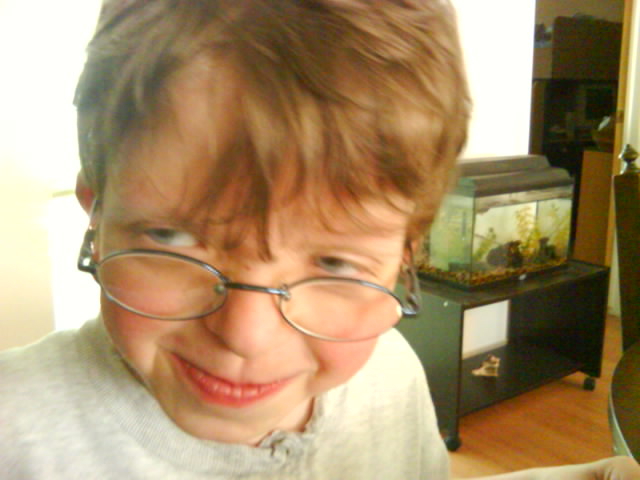
Alex, 2009. His usual charming self.
My A to Z theme concerns the joys and challenges of being the hearing mother of my Deaf son, Alex. To learn more about his beginnings in life, click here to go to my first A to Z entry.
It started with an appointment. My son’s behavioral specialist was to go his school to talk to the teacher to observe him on Tuesday, and then come to see me today. On Tuesday afternoon I received a note from the teacher to say the specialist had canceled due to the flu. I, therefore, assumed she wouldn’t be coming here either. Sure enough, I received a phone call this morning from the behavioral specialist’s office. What happened during that phone call is what’s has me… worried? I wouldn’t go that far: thoughtful, perhaps, ever since.
The nice lady who called me only wanted to let me know my appointment was canceled and would be rescheduled. In order to seem, I don’t know, friendly, or sociable, I felt the need to explain that I already knew the behavioral specialist was sick, since she’d canceled Tuesday’s appointment. But even while I was explaining this, my inner editor was screaming at me, “This is not important to the plot! She doesn’t need to know! She’s probably got a dozen more phone calls to make – let her go!” It’s this conciseness with which I feel the need to write, that makes me wonder what it’s doing to me socially.
And isn’t that true for all of us, to some degree? Whether we’re trying to take shortcuts in speech (how many times have you heard someone utter “lol” out loud? Do you do it?) or cutting ourselves short, as I feel I should have done this morning, it has to be affecting the way we socialize. Writing has become the norm, and speech secondary. We spent far fewer hours with pen and keyboard even twenty years ago, unless it was part of our job, versus talking on the phone or in person. Now our lives are largely lived with the written word.
Writing has always been, in a practical way, different from speech. Drafting a formal letter, whether the recipient is a business associate or a lover, is done with care. Choosing the right words is essential to get the point across. With this in mind, are we bloggers actually better at speaking? Has the practice of finding the correct way to say things, and the editing that goes into many of our posts, improved our skills of communication across the board? And have Facebook and Twitter minimalized our speech to the bare necessities?
I have to wonder how we are evolving. And really, that’s what it is. An evolution of mankind who, at one time walked miles to convey a message, now looks no further than his pocket. We’re not quite to the point that our hands get more use than our tongues, but will we, one day, end up with wrists that bend in odd ways, and mouths that are used only to consume food? But I’m getting ahead of myself (and everyone else).
How we socialize with one another–how we communicate–cannot not be affected by what we spend three quarters of our time doing in order to communicate. Small talk is how we connect with one another. It’s how we discover our shared sentiments. It’s what we do on Facebook and Twitter, but without the human interaction–or at the very least it’s human interaction with a machine as a buffer. Will there come a day when we save our small talk only for such situations as taking pictures of our food on social media, and keep our direct interaction as a form of necessity? I think you really have only to look around a restaurant, or peer into people’s kitchens at dinner time these days for the answer.
Multiple times in the past few months I’ve been to see doctors who haven’t told me the whole story. I suppose there’s a fine line they need to tread – some patients don’t want to know. I, however, do not fall into that category.
The first was my optician. I went for a checkup where I was told I needed to make sure I wear sunglasses when I go out and to make sure I rest my eyes occasionally when I work on the computer. No problem, right? So a few weeks later I bought sunglasses and I during that time walked away from my screen once every couple of hours.
Then I went back to see the optician because I was still having trouble.
“Oh, you have the beginnings of a cataract,” she told me this time.
“I what?!?”
“Yes, that’s why I told you to wear sunglasses and to rest your eyes.”
Had I been told that in the first place, I might have been a little more diligent, don’t you think? I didn’t say those exact words out loud, but the answer to what I did say went something like, “I didn’t want to scare you.”
Right.
Next, my shoulder. As you know if you’ve been reading my blog for a while, I have a rotator cuff injury and tendonitis. I’ve been told by numerous doctors over and over not to push myself past my pain limit. Until today I didn’t know why. Wanna know why?
Apparently if I put too much pressure on my tendons when they’re swollen and inflamed they can snap. Break right in two. Then I’ll have to get into surgery within 24 hours or I can say goodbye to the broken tendon for the rest of my life. I was told by the doctor (a resident working under my family doctor) that if I hear or feel a snap I’ll see my arm swell as the muscle, free of being held in place, runs down my arm and pools at my elbow… Nice, eh?
Had I been told that in the first place… See above.
Again, I understand there are people in this world who wouldn’t want to know these things about their bodies. But there’s nothing quite like the worst case scenario to keep a person from doing something stupid out of ignorance.
Our physicians’ job is to help us heal. It’s also within their power to protect us from ourselves by either giving us the information we need – or not. Communication is of the utmost importance. If we want to know, we have to tell them and they need to be honest; it goes both ways.
Would you want to know? Because if not, I strongly suggest you follow your doctor’s instructions to the letter. You don’t know what kind of pain you’re in for otherwise.
I had a dream last night in which I traveled back in time, to the ’70s I believe, to speak to high school girls about what it would be like, in the future, to be able to communicate from anywhere. You’d think I’d have had a cell phone in my hand. But that’s not what I had.
In my dream I was carrying a piece of paper. It was like a receipt and it had words and numbers written on it. Strangely enough I remember having to go to a payphone to use it… but what purpose the paper served is beyond me. It was a dream.
When I woke up, however, it left me wondering about the fragility of communication. The paper was nothing but symbolic. What if I lost it? (The piece of paper or the ability to communicate – you decide.) What if I suddenly couldn’t read it because it got damaged? How much did it cost to obtain it? It was a receipt, after all.
Then I started thinking, what if I had five minutes to tell everyone I loved everything I needed to tell them? Could I be succinct? I think that’s the one positive thing the language of texting has provided us with… a shorthand. And it’s such a personal thing as well. Only if I’m in a hurry will I spell ‘you,’ ‘u,’ and everyone close to me knows this, and so I am communicating two things at once.
But what if we could all speak the way the great authors write? To be able to communicate a feeling – ‘All the world’s a stage…’ What if stuff like that just rolled off our tongues as easily as we wrote it? What if we could put real body language and facial expressions into our emails? Speaking from the perspective of someone who actually CAN communicate in two languages simultaneously (spoken English and American Sign Language), it would be wonderful indeed.
And yet do I feel as though, if I had five minutes left in this world to say everything I wanted to, I’m afraid I’d be at a loss for words.
That’s not to say that my house is full of stuff I’m never going to use. In fact I love throwing things away. Keeping my life as simple as possible, by not buying what I don’t need and not keeping what I haven’t used in years is something I strive for.
No, my hoarding is reserved for my technological devices. I keep everything, sent and received. Thank goodness for online resources, because I don’t own enough hard drive space to store everything I keep by a long shot.
Why do I keep everything? Some of it is obvious. Pictures, for example, are not easily replaced when they are of family. And stories – I have some as old as ten years and more. Looking back I can see what I’ve done to hone my skills… or at least I like to think I have.
However, it’s my stash of emails that I find the most useful and fascinating. I’m continually moaning about what modern technology has done to disintegrate social interaction: it has become easier and more efficient to email or text than talk to one another. But that’s where the beauty lies.
I remember having arguments with people about what they said or didn’t say. Sometimes these conflicts would last hours, days, even months, and they could never truly be resolved because it was one person’s word against the other. You see where I’m going with this, right?
Now, not only can we retain proof of what was said, a well organized collection of communication can even make it easy to find what we’re looking for, and at the click of a button, we can obtain a proof-positive record of exactly what went down. Not only that, we can record with ease, pictures of the point we’re trying to prove. Say, for instance, you have a friend who ALWAYS does something – take that funny face they make when they’re concentrating for instance – but they are convinced they don’t do it. With technology at our fingertips, all we have to do is whip out that handy phone, snap a pic, and Voila! Told you so!
You didn’t tell me you were going to meet me at 8pm on Thursday for drinks? HA! Here’s the text that proves it!
So there you have it. The reason I hoard everything; because I never know when I’m going to want to prove a point.
And possibly why I don’t have very many friends. 😉


 lindaghill.com